Monday, November 23, 2015

Double Your Steve Railsback Fun

Cole's painting of Angie's anxieties in SCISSORS (1991)


Well, darlings, I've been away but now I'm back. In addition to me starting a new job and fighting off a monster cold, Assistant District Attorney Jim Gillespie is all bent out of shape over his impending divorce. Honestly, I can't blame his wife because he's unrepentantly abrasive and often disgusting, but Butch Walker thought that to help him feel better we should take him to the movies. In theory this is a good idea, but the last time he, Butch and I went to a double-feature of EVIL DEAD and EVIL DEAD II, he embarrassed the hell out of me by barfing all over the front row. It wasn't even because the movies were gross, but because he discovered Chivas Regal, lithium and two double-beef supremo burritos don't mix. Also, if Jim insists on driving, his car smells like stale cigarettes and Guinness sweat and he insists on blasting MEAT LOAF's Bat Out of Hell at top volume while he tries to run over pedestrians so riding around with him is a pretty horrifying experience.
But hey, sometimes friendship is a messy job.

And speaking of difficulties with adult relationships and good things that come in twos, today I'm talking about SCISSORS (1991), the long-lost cult-classic-to-be thankfully now available for the first time on DVD and Blu-ray from the good people at KINO-LORBER, written and directed by FRANK DE FELITTA, the madman behind AUDREY ROSE, the BARBARA HERSHEY-demon-rape-classic THE ENTITY and the made-for-TV great DARK NIGHT OF THE SCARECROW; starring a pre-stardom SHARON STONE as the neurotic heroine and featuring DESCENT INTO MADNESS favorite STEVE RAILSBACK in a dual performance as twin brothers.
My obsession with the beloved MR. RAILSBACK may border on the unhealthy. Seeing his name on the screen just fills me with child-like glee. Not only did he traumatize a whole TV-watching generation with his portrayal of CHARLES MANSON in HELTER SKELTER, but he maintains status as a cult icon, injecting every role with his offbeat, mildly unhinged charm. Seriously, is there any other movie like THE STUNT MAN or LIFEFORCE? And who else would've brought such a quirky sense of humor to infamous Wisconsin cannibal Ed Gein? Sometimes I imagine him miraculously appearing in a scene to liven up boring movies. It does not hurt that he is a fellow Texan either.
Also, am I the only one who finds his distinctive voice strangely soothing?


Steve Railsback as Alex Morgan in SCISSORS (1991)


I found out about this film thanks to the good folks at KINDERTRAUMA. And while SCISSORS may not be everyone's idea of a masterpiece, I couldn't help but be charmed by it. With its multiple red herrings, soap opera melodrama, mad psychiatry, undercurrent of sexual perversion and histrionic HITCHCOCK hodgepodging (MARNIE particularly), it reminds me of a less violent giallo film. Sure, it doesn't really make much sense if you think about it too hard, but just go with it and you might enjoy it.
SHARON STONE stars as Angie Anderson, a young woman from Tulsa who lives in a strange version of Chicago that looks like Los Angeles. Angie leads a reclusive existence, taking temp jobs and devoting a majority of her time to repairing dolls and hanging out with her cat. Angie is also plagued by repressed childhood memories involving a man named Billy, a strange repulsion and fascination with a decrepit pig puppet and an intense fear of sex. One night, she is attacked in an elevator by a man with a red beard and defends herself by stabbing him with a pair of sewing scissors. She meets and is comforted by her neighbors, the Morgan brothers, gentle, bespectacled soap opera actor Alex and his scruffy, wheelchair-bound, artist twin Cole (it's RAILSBACK in stereo, folks!). Angie and Alex develop romantic feelings for one another and I quickly realized that I would be a fan of romantic comedies if they featured STEVE RAILSBACK as the male lead. Alex, unlike the other men around her, is dependable, patient and kind. However, despite her hesitant attraction to Alex, Angie remains fearful.
Anyhoo, Angie is called for a temp job and ends up trapped in an apartment that was apparently decorated by the production designer of SUSPIRIA with the corpse of a red-bearded man (stabbed with her pair of scissors, by the way) and a giant blackbird that cackles, "You killed him! You killed him!"
Oh yeah, and then there's some stuff about Cole and how he's faking being crippled and trying to scam Alex and is menacing Angie, Alex's jilted ex-girlfriend who still carries a torch and Angie's psychiatrist feeling romantically neglected by his ambitious politician wife.

Okay, you've got me: SCISSORS is pretty ludicrous but its enjoyably so. The more you learn to embrace its insanity and SHARON STONE's eye-bulging hysterics, you'll sink into it like a warm bath. Angie's descent into madness is simultaneously silly in its hyperbole and brilliant. Moments recall ALICE IN WONDERLAND, such as the scene where Angie attempts to twist the doorknob only to find it is made of rubber and comes off in her hand and drops down the steps or where the corpse of the murdered man is seated at a child's tea party table while Angie wanders around the apartment in a fugue state.
Aside from me succumbing to the film's RAILSBACKian charms, I think SCISSORS tapped into some personal anxieties I was experiencing at the time.

WARNING: HEREIN THERE BE SPOILERS


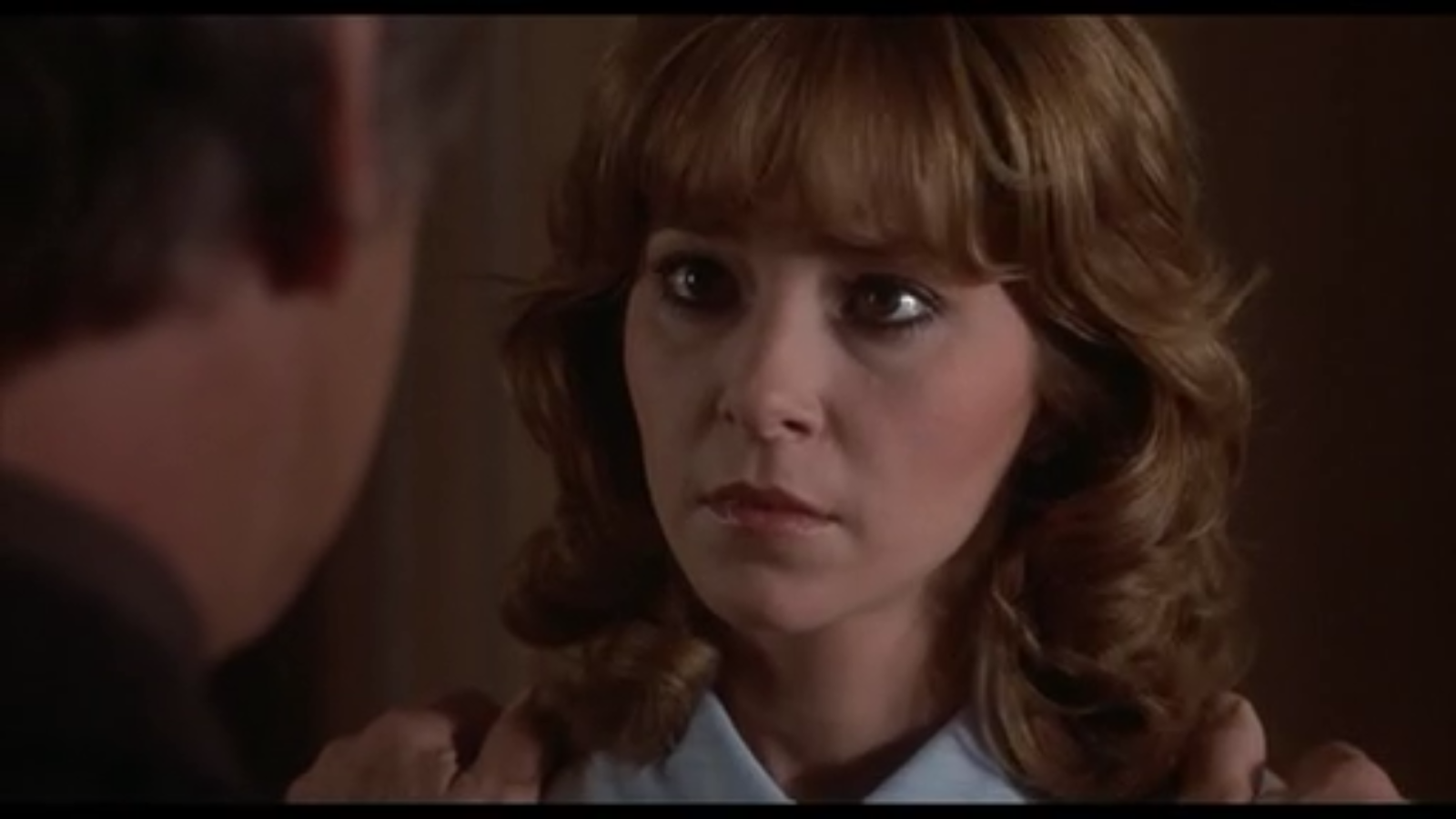
Angie (Sharon Stone) and Cole (Steve Railsback) in SCISSORS (1991)


The source of Angie's anxiety, much like her long-lost cinematic sister Marnie Edgar, is an episode of childhood trauma involving the touch of another followed by violence. As a little girl, Angie was molested by her red-bearded stepfather under the guise of a game with a pig puppet. This was discovered by Angie's mother, who stabbed him with a pair of - you guessed it - scissors. As an adult, Angie has repressed the memory due to her inability to cope with this substantial trauma. The pig puppet evokes fear but she also uses it to comfort herself in times of distress. Despite the silliness of SCISSORS, I think this element is a realistic depiction of the ambivalence of someone who has experienced childhood sexual abuse. As a young girl, Angie was grateful for the extra attention from her stepfather, ("Do more, Billy, do more," she giggles) but the unwanted touching left her with deep sense of guilt and shame.
She has learned to regard any touch from a man as violation rather than affection.
It's not only men that Angie distrusts, she does not have any female friends she can depend upon either. "I keep to myself," Angie says.
And hey, I can get that. Through most of my young adult life, I was pretty wary of friendships and romantic relationships. I always felt nervous and out of place among my peers partly because I seemed to be surrounded by the kind of people who watch a Marx Brothers movie and say, "Well, I like MARGARET DUMONT -- but I can't stand those three weird guys that are always running around." But also partly because I had learned that people were not to be trusted.
The only time I felt safe was watching horror movies about troubled and damaged people. People can yap all they want about the harmful effects of violent movies, but horror movies are what helped me heal.
Angie's hobby of repairing dolls may be her way of symbolically fixing the damage inflicted upon her during childhood and saving herself.
Alex remarks that one of the reasons he's attracted to her is because he's seen her dolls and loves how she makes broken things beautiful. Indeed.


Angie (Sharon Stone) and Alex (Steve Railsback) in SCISSORS (1991)


Angie struggles to heal and understand her anxieties. She wants to have a relationship with Alex as she senses he is a trustworthy and caring partner. She is not abnormal, but has retreated behind protective barriers she does not entirely understand. In one scene, she undresses sensually in front of her mirror as if in a trance. She possesses healthy, sexual feelings but only feels safe to express them when she is alone. However, at the sight of the pig puppet, she freezes and quickly covers her breasts.

It's interesting that the only thing the three lead male characters have in common is that each of them pretends to be something he isn't. Cole feigns being crippled. Alex is an actor portraying a psychiatrist on a soap opera. Angie's real psychiatrist (played by RONNY COX of DELIVERANCE and THE BEAST WITHIN fame) turns out to be her captor and tormentor.
It's also interesting that Alex, who only portrays a psychiatrist, is more instrumental in Angie's healing process than her actual psychiatrist who proves to be a wolf in sheep's clothing.
Psychiatrists - particularly male psychiatrists - are generally not portrayed well in genre film. Many feminists adopted an anti-psychiatry stance, believing psychiatry to be another agent of the patriarchy to control female behavior. Hey, just ask ZELDA FITZGERALD or FRANCES FARMER.
In SCISSORS, Angie's psychiatrist, Dr. Carter, rather than help her develop tools she needs to cope with her anxieties about sex and relationships, invalidates her concerns and spends most of the session dredging up past trauma. Naturally, this does not help. He also takes a personal phone call during their session which is most unprofessional.
Far worse, though, he is a manipulator rather than a healer, using Angie as a pawn in a scheme for revenge against his adulterous wife who has injured his male ego with her career ambitions and her extramarital affair. Angie has again been violated by someone she trusted.
However, I think the road ahead for Angie at the end of the film is a positive one. Dr. Carter scoffs that she is descended into a psychotic state that she won't come out of anytime soon. But even though Angie appears to be in a daze, she walks out, shutting the door on her past and leaving her captor locked inside the trap he created.
Once outside, Angie looks up from the street and offers Dr. Carter a triumphant half-smile. Though wounded by the experience, she has confronted her childhood demons and survived. She rides off with Alex to a brighter future.

So, hey, in all its goofiness, I guess you can say SCISSORS had a profound effect on me. And I now feel the urge for a STEVE RAILSBACK marathon.

Friday, November 6, 2015

Beware of the Naked Man


Charles Bronson aims to wipe the scum off the street in 10 TO MIDNIGHT (1983)


Pardon me while I old all over the place, but a lot of things were better in olden times. Jobs were plentiful. Fewer guys named Todd. Political correctness was non-existent. Hipsters had yet to infest every city center with their ham-fisted attempts at irony. People weren't perpetually auditioning for their own reality-TV show.  But most importantly of all, there were video stores. I know there are a few jerks out there who'll pipe up and say, "But it's so much more convenient to stream - any movie you want is available at just a click of a mouse!" I will retort first by saying, "Get off my damn lawn, you whippersnapper!" And second, for those of my readers that did not come of age during the magical era of VHS, there was just something special about taking a journey to your local video store.
First of all, you didn't have the privilege of remaining isolated and you were forced to know how to interact with other people to obtain the movies of your choice. And sometimes instant gratification just isn't everything. LAST HOUSE ON THE LEFT, ERASERHEAD, SLEEPAWAY CAMP and HENRY: PORTRAIT OF A SERIAL KILLER hold so many more special memories for me because I had to embark on a quest to find them.
Once you arrived at the video store, you had the chance to browse through rows and rows of creative box art and discover hidden gems. That's how I stumbled upon ALICE, SWEET ALICE and that remains one of my favorite movies to this day. On the other hand, that's also how my high school best friend and I ended up renting NAIL GUN MASSACRE. This was before the day of hideously Photoshopped floating heads, so looking at all the box art was a thrill in itself.
Then when you finally selected your movie, you got to talk about your rental with the sardonic clerk who had ostensibly seen every single movie in the store.
And now that video stores are gone, where the hell are smart-alecky people who have seen too many movies supposed to work? Automating people out of business is how that TEXAS CHAIN SAW MASSACRE family got started!
And do we really want to give away all of our jobs to machines? We're turning this whole damn country into WESTWORLD!
These are the thoughts that kept me out of all the good schools.
And speaking of thoughts that kept me out of all the good schools, let's celebrate everything I loved about the heyday of VHS and also CHARLES BRONSON's birthday week with 10 TO MIDNIGHT (1983), a sleazy slasher-inspired action flick from those bastions of good taste at Cannon Films.


Charles Bronson as Leo Kessler in 10 TO MIDNIGHT (1983)


The Bronsonator plays Leo Kessler, a hard-nosed quiche-hating Los Angeles homicide detective who's tired of creeps finding loopholes to evade justice. With the help of college-educated new partner Andrew McCann (ANDREW STEVENS), Kessler investigates a series of homicides of young woman. The perpetrator is none other then Ted Bundy-inspired (he even drives a tan VW bug!) office equipment repairman, Warren Stacy, who despite his buff physique has trouble attracting a date. Warren's misogyny and painfully fragile masculine ego prevent him from relating to women as anything other then contemptible pleasure objects and does not understand why his condescending, abrasive advances are met with rejection.
Hell hath no fury like a developmentally arrested man-baby scorned, and Warren stalks his unrequited objects of lust before stripping buck naked and stabbing them to death. Not only does this method of murder serve as a substitute for sex in which Warren can have total dominance, but also conveniently does not leave physical evidence.
Warren also has a knack for arranging airtight alibis, which makes Leo's pursuit of him all the more difficult. When Warren sets his perverted sights on Leo's feisty student nurse daughter, Laurie (LISA EILBACHER), Leo decides to take a shortcut and plant a little evidence.
Unfortunately, Warren just hires cynical, amiably sleazy crackerjack criminal defense attorney Dave Dante (character actor extraordinaire, the late beloved GEOFFREY LEWIS) and is sprung free to pull a Richard Speck and slice and dice a houseful of student nurses into veal cutlets.
Then it's time for the Bronsonator to dispense some good ol' fashioned street justice.


Gene Davis as Warren Stacy, the rampaging naked serial killer in 10 TO MIDNIGHT (1983)


Other reviewers have noted that 10 TO MIDNIGHT has much more in common with DIRTY HARRY than the DEATH WISH films for which BRONSON became famous, with its disillusioned detective, sadistic serial killer and critique of a criminal justice system that does nothing to protect its citizens from savvy predators. 10 TO MIDNIGHT also incorporates elements of slasher films, which were extremely popular at the time. The first victim is dispatched FRIDAY THE 13TH-style while having sex with her boyfriend in a van parked in the woods. Warren's systematic stalking and slashing of the house full of student nurses is a cornucopia of slasher tropes including a shower attack, a potential victim hiding under a bed while another victim is stabbed to death right above her and a prolonged chase of the Final Girl.
And can you really die from being stabbed in the stomach because according to this movie and the FRIDAY THE 13TH sequels, that's completely plausible.

It's a pretty well-acted and entertaining movie. J. LEE THOMPSON, stalwart action director who helmed the Gothic-infused slasher delight HAPPY BIRTHDAY TO ME a few years earlier, keeps everything stylish and snappy. BRONSON brings his usual likability and commanding presence to a stock role. Likewise, ANDREW STEVENS is good as his more ethical idealistic partner and potential love interest for the leading lady. My favorite, though, is LISA EILBACHER as Laurie Kessler. Most slasher movie Final Girls are still in their teens or in college, but Laurie is a grown woman trying to overcome childhood baggage as she progresses through adulthood. Though she still has a relationship with her father, it is clear he was often estranged from her and eschewed his parenting duties for the sake of his career. With the loss of her mother at a young age, Laurie ostensibly raised herself. Though she bears some reasonable resentment, she is not portrayed as incomplete or damaged. She is confident, tough-but-vulnerable, sassy and resourceful under distress. EILBACHER is refreshingly natural in the role and as a result, Laurie is always relatable.


Lisa Eilbacher as Laurie Kessler in 10 TO MIDNIGHT (1983)


GENE DAVIS is unfortunately wooden as Warren Stacy, often coming off as petulantly pissy rather than cold-blooded. However, the portrayal strangely works in the character's favor: a grown man pitching tantrums is far more repellant than any psychopath.
And you will never hear anything but gushing praise from me about GEOFFREY LEWIS, particularly when he is playing a gleefully sleazy attorney.
But while 10 TO MIDNIGHT is shamelessly entertaining, let's look at its depiction of the legal system.
Real life has little influence over Hollywood and I doubt any producers have been in a court room unless it's for their own cocaine possession. Therefore, 10 TO MIDNIGHT's sanctimonious assertion that the system is broken is pretty riddled with holes.
I can't exactly say the same for its brethren DIRTY HARRY, which arose from '70s cynicism about the institutions we constructed to protect us but failed to do so and fear that perhaps society had gone too far to one end of the spectrum to ever return to a balanced center.
In Harry Callahan's hunt for Scorpio, he acts under a ticking clock, determined to save a teenage girl who has been buried alive with only a few hours to live. He adheres to the rules until necessity dictates otherwise. I can't speak for Constitutional law in the early '70s, but Harry's obtaining Scorpio's rifle (which he does in the course of his legitimate search for Scorpio) and finally catching Scorpio himself are acceptable considering the extraneous circumstance. And while roughing up Scorpio would have a penalty, a human life hanging in the balance takes precedent over the right to a lawyer.
Harry Callahan cries that "the law's crazy" because he has done the right thing to save a young girl's life and prevent a dangerous (not to mention racist, homophobic and misogynistic) psychopath from hurting others. He is prevented from maintaining justice for the people by heartless bureaucrats who seem to care more about technicalities of the law than the citizens those laws were created to protect.
On the other hand, Leo Kessler planting evidence on Warren isn't in pursuit of justice, just sloppy police work. He is emotionally invested because Warren has involved his daughter and takes a short-cut.
I also don't think it was proper police procedure to illegally seize Warren's sex toy and brandish it at him during an interrogation ("Do you know what this is for? It's for jackin' off isn't it?" Leo snarls). No matter how freakydeaky he thinks it is, it's irrelevant to the murder investigation and I doubt he could get a judge to sign a warrant for it.


Leo Kessler (CHARLES BRONSON) is mystified by Warren's sex toy in 10 TO MIDNIGHT (1983)


10 TO MIDNIGHT would have us believe the criminal justice is full of loophooles in which clever criminals are all able to afford top-notch lawyers and manipulate their way back onto the street as wishy-washy liberals wring their hands and shrug over technicalities.
The legal system is flawed and not always fair (might equals right far too often), but not in the way the film depicts.
There's a misconception that Constitutional rights are only there to protect murderous psychopaths and child molesters go free, when the most commonly quoted statistic is that 97% of criminal defendants are ruled guilty.
Most of the judges in criminal court (at least where I live) are former prosecutors and therefore inclined to believe everyone is guilty. And there are a large chunk of defendants not poor enough to be eligible for a public defender but too poor to afford a private attorney, so most go without the skilled representation of a legal artist like Dave Dante.
And the number of defendants freed due to technicalities, in my experience, are zero. Exceptions are made if the investigating officers were acting in good faith. If a defendant is acquitted due to their Constitutional rights being violated, the investigating officers were negligent or corrupt in performing their duties.
In fact, if Warren Stacy were not such a despicable creep, the audience would be howling over lack of police ethics.
I also doubt that an attorney as savvy as Dave Dante, no matter how unethical, would propose an insanity plea as an alternative to the death penalty when there is clear evidence that the defendant was aware his criminal actions were wrong. Additionally, in California (as in several other states) the burden of proof would be on the defendant so I doubt this would have been proposed as a cavalier solution.


Criminal defense attorney Dave Dante (Geoffrey Lewis) and Warren Stacy (Gene Davis) in the court room in 10 TO MIDNIGHT (1983)


Though Leo remarks that Dave Dante is scum, Dave is the one who is just doing his job. Everyone is entitled to the best defense possible (or at least one within their financial means) and Dave is simply defending his client to the best of his ability. It's Leo's sloppy and unethical police work that guarantees Warren Stacy will go free.

In the context of the film, I love the ending. It's dramatically satisfying and I don't know if anyone could have brought as much gravitas to that moment as CHARLES BRONSON does. However, in the context of the real world, Leo Kessler would then be rushing to obtain the services of a Dave Dante-type criminal lawyer he once hypocritically denounced.
Would the system still be considered to be broken if Leo were to be acquitted for murder? That's a question the film doesn't bother to consider.

Well, Constitutional law aside, 10 TO MIDNIGHT is good ol' fashioned exploitation fun and I don't think it's ever possible for me to dislike a CHARLES BRONSON movie. Even in those later DEATH WISH sequels where he starts rockin' sweat suits and starts to look more like ED ASNER, I still just love the guy. ROGER EBERT declared 10 TO MIDNIGHT to be "a scummy little sewer of a movie" and that "the people who made (it) have every reason to be ashamed of themselves." That's quite a compliment from the guy who penned the great trash classic BEYOND THE VALLEY OF THE DOLLS!

And while searching for a clip of the ending, I discovered this clip which made me love the Bronsonator even more.
I knew we were always on the same page!


Monday, November 2, 2015

Death Has Come To Your Little Town, Sheriff


Michael Myers ready with a knife in HALLOWEEN (1978)


By the time I post this, it will be after midnight, but it's Halloween every day of the year in my heart. And there was a hell of a night in my neighborhood too. Those jerks across the street, of course, had their Hallelujah house with undead cheerleaders gushing blood from botched abortions and gay men transformed into monsters by some unspecified disfiguring STD.
I thought maybe Otis Calhoun had given up. I thought maybe that prison bromance had softened him up.
But nobody bears a grudge quite like a Southern redneck.
In the distance you could hear the growl of the motorcycle and the sound of two men howling like wolves. Then out of the darkness of the night, Otis Calhoun emerged, riding on the back of his brother Lyle's motorcycle, dressed as Bluto from ANIMAL HOUSE and carrying a jack o' lantern with one hand and a Wild Turkey bottle in the other. He bellowed something that sounded like, "Chug a beer for Satan!" and, like he did many years before, hurled the jack o' lantern straight through the brand new picture window. Then Lyle plowed the motorcycle straight through the garage where Otis sprayed all the Hallelujah house with bourbon.
From that point on I lost track of all the mayhem, but there are emergency vehicles around the block and it looks like the Thomas's garage is on fire. I have a feeling November is going to be a busy month for Otis Calhoun's parole officer and Butch Walker, who's excited that Otis is back on the streets because he needs a new car.

And speaking of Halloween mayhem, it's time for the film that inserted the holiday into the annals of horror history. That's right, before JOHN CARPENTER and DEBRA HILL came along no one had made a horror movie about Halloween before. The tenth film in the 31 Days of Halloween review-a-thon is none other then the seminal low-budget classic HALLOWEEN (1978) written by DEBRA HILL and JOHN CARPENTER, directed by JOHN CARPENTER and starring the ultimate Scream Queen JAMIE LEE CURTIS as the shy babysitter besieged by the boogeyman.
Even if you haven't seen the film, you know the plot and it was re-used and re-invented countless of times by both independent and studio imitators.
The film opens with a point-of-view tracking shot through a house on Halloween night. This is already disorienting to the audience as we don't know who we are or why we're grabbing a butcher knife out of the kitchen drawer. We are both a helpless voyeur and complicit as seventeen-year-old Judith Myers is stabbed to death after having sex with her boyfriend. And the guy was a total minute man too.
To our shock, we discover the perpetrator is six-year-old Michael Myers, her little brother.


Six-year-old Michael Myers has killed his sister in HALLOWEEN (1978)


Fifteen years later, Michael's psychiatrist Dr. Samuel Loomis (veteran DONALD PLEASENCE) insists Michael should never be released; He's purely and simply (dramatic pause) evil.
But before he can be transported to a maximum security institution, Michael escapes and heads back home to Haddonfield, Illinois, right in time for Halloween.
Shy, thoughtful Laurie Strode (JAMIE LEE CURTIS) has an evening of baby-sitting planned while her more extroverted friends sardonic Annie (CARPENTER regular NANCY LOOMIS) and boy-crazy Lynda (cult favorite P.J. SOLES) are trying to sneak some sex and underage drinking into the mix. But little do they know of the evil that is stalking them...

Many reviewers interpreted the film as reactionary and puritanical due to the fact that the virginal Laurie survives the night while her sexually active friends are made into mince-meat, but I think this is an overly-simplistic view. HALLOWEEN was created in an eye of a cultural storm: after a decade of social upheaval and economic crisis, there was finally calm and affluence. I'm sure many were convinced this return to stasis would not last and this contributes to the point of view of the film that we are never really safe, no matter how many protections we have.
Evil is not in an Old Dark House or in the rural badlands: it has invaded upper-middle-class suburbia.
In some sense, the Michael Myers character is a reaction to the cultural results of the feminist movement and the sexual revolution but not quite in the way most reviewers have hypothesized. CAROL J. CLOVER, writer of the brilliant MEN, WOMEN AND CHAINSAWS, has stated the audiences for HALLOWEEN and the slasher films that followed are "the children of feminism." Following both social movements, the divorce rate rose substantially and the family dynamic changed permanently. Many children now came from homes with a single, working parent and did not have as much supervision and attention as their counterparts of previous generations.
At the same time, because of the economic boom following a decade of turmoil, society shifted from social consciousness to instant gratification.
Michael Myers is representative of the anger of the latch-key kid generation which lost some of their own childhood due to the actions of adults.


Laurie (Jamie Lee Curtis), Lynda (P.J. Soles) and Annie (Nancy Loomis) in HALLOWEEN (1978)


His older sister, who is supposed to be taking care of him, ignores him to have sex with her boyfriend. It is not the act of having sex that signs these character's death warrants: it's the preference for instant gratification over responsibility.
Sex in American culture is perceived as an entrance into adulthood. Therefore in horror films, it's not sex being demonized but the fear of adulthood and the loss of childhood innocence.
Michael, in his fear of adulthood, remains a developmentally arrested child. When he is briefly unmasked near the end of the film, his facial features are child-like and boyish. Like most Americans, he is repelled by sex and cannot perceive women as anything other than mothers or whores.
His inability to mature and to comprehend the changing world around him in turn causes him to completely lose any sense of identity or personality. He becomes nothing but a robotic killing machine seeking out sister surrogates to punish, all the while wearing a featureless mask.


Michael Myers pins Bob to the door in HALLOWEEN (1978)


HALLOWEEN, like all horror films about teenagers, is a coming-of-age film underneath all the stalkings and stabbings. Laurie is far more responsible then her instant gratification-seeking friends. She's on the other end of the spectrum, completely selfless and always doing things for other people. But Laurie is at an age where she is deciding what kind of woman she would like to be. Like Michael, she has reservations about adulthood but she does not allow her fears to arrest her. Though introverted and studious (her hobbies are reading and knitting), she is not quite the prude that many reviewers construe her to be. After all, she gets high with Annie right before her baby-sitting job. Like most teenagers, Laurie is curious about sex and romantic relationships, but she's not going to rush into anything before she is ready. Unlike her friends, she knows both these things entail responsibility. The deaths the sexually active characters face, in addition to the death of their childhood, could also represent the ramifications of sexually transmitted diseases and unwanted pregnancy.
"Guys think I'm too smart," she shrugs.
Laurie's transition into adulthood is achieved through survival; she is resourceful and courageous in the face of adversity. In surviving her battle with Michael Myers, she not only grows from child to woman, but grows into the kind of woman that she wants to be, rather than what other people want her to be.
It's arguable over which horror movie character deserves the title of First Final Girl, but its undeniable that Laurie is the template future Final Girls adhered to.
I really resent those boneheads whining that HALLOWEEN is anti-feminist when Laurie demonstrates herself to be intelligent, resourceful and strong. She would like to have a boyfriend but is independent enough that she does not need one to define herself.
Laurie Strode is a feminist.


Jamie Lee Curtis as Laurie Strode in HALLOWEEN (1978)


And while I'm talking about strong, resourceful women, let me take a moment to give a shout out to the late DEBRA HILL. Not only did she co-write and produce one of the most influential horror films of all time, but she rose through the ranks of low-budget horror to become a successful producer in male-dominated studio Hollywood. That's no small feat, I can tell you.

But as much as I love Laurie, Annie Brackett may be my favorite character. The sarcastic best friend is a favorite horror movie trope of mine as that's the role I play in real life. Though I would probably face sudden death at the knife blade of a masked maniac for being so sassy, I just can't shut my mouth. NANCY LOOMIS grants her a terrific HIS GIRL FRIDAY-style snappy delivery, and aside from Dr. Loomis, has the best lines in the movie.
"I hate a guy with a car and no sense of humor."


Nancy Loomis as Annie Brackett in HALLOWEEN (1978)


And what about Dr. Loomis you ask? It's through his character that the film explores the concept of evil. In HALLOWEEN, evil has no explanation. Do we ever really find out the specific reasons why a six-year-old boy would stab his sister to death? The sequels would posit all kinds of theories but here, there is no real explanation. The graveyard cartetaker, Mr. Lowry, tells Loomis another tragic story involving hacksaw mayhem one town over, remarking that "every town has something like this."
Evil is not exclusive to Haddonfield it is everywhere in every small town in America. As mentioned before, no one is safe from it. Even Laurie in her hesitancy to take risks is not safe.
Evil in HALLOWEEN is an unstoppable force of nature. In Laurie's high school philosophy class, the lecture focuses on the idea of fate.
"Fate is immovable like a mountain...fate never changes," the teacher lectures.
Perhaps this implies that the mayhem transpiring on Halloween night was meant to happen and there are larger forces at work.
He is equated by Tommy Wallace, Laurie's baby-sitting charge, to the boogeyman: an all-purpose monster symbolizing all things that are malevolent to children. The boogeyman, too, is a way we try to understand the forces of evil in the world through myths and stories.
Michael Myers is the equivalent of a hurricane, with no emotions or personality to hinder him, leaving a path of death and destruction.


Laurie Strode (Jamie Lee Curtis) does not realize Michael Myers has risen behind her in HALLOWEEN (1978).


He cannot be stopped. Laurie stabs him with a knife, stabs him in the eye with a coat hanger and stabs him in the neck with a knitting needle but he still will not die.
Even after six gunshots and a fall from the second story, Michael survives.
He is both a supernatural monster and a human monster. Supernatural in that he is more force of nature than human. He is both the inexplicable evil that men do and a vessel for the forces of evil themselves.
In the last scene of the film, Loomis looks down where Michael's body once lay and finds that it is now gone. He is unsurprised; he knew this would happen.
There is a montage of all the places Michael has been that night, now empty, as we hear his labored breathing over the soundtrack.
Not only can evil not be defeated, it's everywhere.


Donald Pleasence as Dr. Sam Loomis in HALLOWEEN (1978).


With his featureless white mask, robotic compulsion to kill and supernatural abilities, Michael may also represent the ultimate force beyond human control.
"Death has come to your little town, Sheriff," Loomis states.
Michael Myers is also the equivalent of the Grim Reaper and our ultimate fate that cannot be defeated, death.
As one leaves their childhood and teenage years behind, death looms a little closer.


Annie (Nancy Loomis) does not realize Michael Myers is lurking outside in HALLOWEEN (1978).


It's through stories of the boogeyman and horror movies that we can attempt to understand the forces of evil in this world and help face our fear of death safely.
Laurie is an observant young woman and, as someone tentative to act, she is a watcher. In that respect, she is representative of HALLOWEEN's audience. Those that watch HALLOWEEN do so because they are trying to face their own fears.
While much attention has been paid to the fact that sequences in the film are shot from Michael's point of view, they forget to note that there are also sequences shot from Laurie's point of view. While Michael is a representative of evil, Laurie is a representative of good and both these forces are a part of us.
Unlike her friends, who are not interested in facing anything going on around them and instead settle for the brief escapism of sex, drinking and drugs, Laurie observes, is brave enough to investigate when she suspects something is wrong and strong enough to survive her brush with evil.
Ignoring the problem does not make it go away and it's Laurie's perceptiveness and her strength to face things rather than hide that allows her to survive the night more then her status as a virgin.
 

Laurie Strode and Tommy Doyle watch the horror movie marathon in HALLOWEEN (1978)


Saturday, October 31, 2015

Dance of Dearth


Jack o' lantern in CREEPSHOW (1982)


Unfortunately, I got behind in my 31 Days of Halloween review-a-thon because I got called in for a job interview in Atlanta. I decided to go because I have always heard there are cities where seeing a sheriff's deputy swerving all over the road because he's trying to balance his police radio in one hand and a long-necked Corona in the other is not a common occurrence and I had to investigate that for myself.

Well, after driving all day through pouring rain and having my GPS cut out repeatedly while trying to find my hotel, I discovered a few things: 1) For a city with all of its amenities, Atlanta has absolutely nowhere to park, 2) Atlanta drivers are not hesitant about using their car horn at the slightest provocation and most disturbing of all, 3) valet parking proliferates. And gentle readers, I tell ya, there's nothing more I despise more then valet parking. The freedom a hard-working American experiences behind the wheel of their own car is the only privilege most of us have left. But some money grubbing greed swine wanna take that away too and have us pay for the supposed privilege of having a stranger park our car. What kind of Communist conspiracy is that?
Well, after all that, I get to the interview and find that the guy 1) has not read my resume, and 2) has no idea what job I'm applying for even though it was made clear by my cover letter.
"What are you doing now." he asked.
"I'm a writer," I said.
"So, you're unemployed," he sneered.
 After having me tell him information that he could have simply read off my resume, he curtly informed me that he was looking for someone with 10 years experience.
I guess the joke's on him because he'll have a mighty hard time finding someone with 10 years experience wanting to work at a slumming personal injury firm for only $10 an hour and no benefits. Although maybe he can, because there ain't no place quite like the US of A where there is wealth and privilege abounds, but it remains in the hands of a select few while the rest of us are granted the liberty of being taxed to death and groveling for nickels. Hell, where's the French when you need 'em? I say it's guillotine time.

And speaking of class rage and reactionary violence, it's time for the ninth film in the 31 Days of Halloween marathon, the great CREEPSHOW (1982) directed by GEORGE ROMERO and written by everyone's favorite horror Everyman, STEPHEN KING. Some stuffed-shirt academic hambones will try to tell us Big Steve is a hack and that his books are the literary equivalent of a Big Mac, but I think these are the same kind of mush-heads who wrote off EDGAR ALLAN POE and H.P. LOVECRAFT back in the day. They're also the same people who write essays about Malamud and touch themselves and you don't wanna be in that crowd, trust me. For someone to successfully tap into the fears of such a wide variety of people - and to do it over and over again - there is something to them. STEPHEN KING doesn't just write horror, he writes about the average working man and working woman's everyday struggle in America. In addition to battling the forces of the supernatural, his characters also battle bills, family conflicts, their own personal demons, the narrow-minded cruelty and xenophobia of small town folks, and the painful realization that their place in the world is limited and their American Dream may never come true.
Besides, I think he can eat that wussy John Irving for lunch.


Stephen King as Jordy Verrill in CREEPSHOW (1982)


CREEPSHOW is an anthology film, which means it's a smorgasbord with something for everybody. In the wrap-around segment we're introduced to budding horror fan Billy (Steve's own son, JOE KING) whose Dad, despite being played by the awesome TOM ATKINS, is an uptight, overbearing douche. Seems he strongly disapproves of Billy filling his impressionable mind with the gruesome images in horror comics. "I've never seen such rotten crap in my life!" he bellows before slapping Billy and tossing his EC-style Creepshow comic book into the trash. From here, we're presented the five tales from the flapping pages of the comic book.


Stephen King's son Joe King as Billy in CREEPSHOW (1982)


"Father's Day" is a story of revenge beyond the grave in which the domineering patriarch of a wealthy and avaricious clan is murdered by his long-suffering daughter only to return from the grave for his Father's Day cake. I know I'm not alone in my love for older actresses in horror films and like-minded individuals will be happy to know this segment boasts two knock-out performances by CARRIE NYE as the cold-blooded Sylvia and VIVECA LINDFORS as tortured, eccentric Jim Beam-swilling Aunt Bedelia. But despite this, and some impressive dance moves by a then-unknown ED HARRIS, I think this is the flimsiest of the five stories. Something about it always feel anti-climactic to me.
Bedelia is a fascinating character, though, and actually has a lot in common with the characterization of Lizzie in THE LEGEND OF LIZZIE BORDEN. She is a virtual prisoner of a cruel and tyrannical father; he has cast her in the role of his doting nursemaid rather than a daughter, but is never grateful for the sacrifices she has made for him. He continues to verbally abuse her and simply demands more and more. He even goes so far as to murder her beloved fiancée. Driven to madness, Bedelia bashes him over the head with a marble ashtray. Though her abuser is dead and she has inherited his lofty fortune, her guilt gnaws away at her. She cannot enjoy the life she has left and drowns her pain in alcohol. She allows her father to keep her a prisoner even beyond the grave.
Also, something that has always bothered me: why isn't ED HARRIS's character Hank the sole survivor of this segment? He's an in-law, so therefore has no part in the murder being avenged. And he's more of an average, if kind of stupid, nice guy unlike the spoiled siblings, Cass and Richard. Oh, well, I like Cass's white pants. But if she wore them after Labor Day, that in itself should be punishable by death.


CREEPSHOW (1982): Nathan Grantham rises from the grave to punish murderous daughter, Bedelia (Viveca Lindfors).


In "The Lonesome Death of Jordy Verrill," KING himself plays the titular slow-witted country bumpkin who, in a comic version of LOVECRAFT's "The Colour of Outer Space," is overgrown by out of control weeds from a meteor that's landed on his farm.
A lot of people find this segment grating, but it's actually my second favorite as it's the cartooniest of the bunch. STEPHEN KING portrays the ill-fated Jordy with wide eyes, exaggerated jaw dropping and face-slapping like a live-action Wile E. Coyote. His fantasy sequences (in which BINGO O' MALLEY plays each character) are the silly icing on the ham cake. My favorite is his fantasy of a nightmarish doctor's visit, in which a crazed doctor (who, because the camera angle is canted, rolls in on said angle in his rolling chair) informs him his affected fingers will have to be cut off with a meat cleaver.
I think Jordy Verrill and I receive the same quality medical care.
But underneath all the goofiness, it's ultimately a pretty tragic story.


CREEPSHOW (1982): Jordy Verrill (Stephen King) pays a visit to crazed doctor (Bingo O' Malley) in CREEPSHOW.


In "Something To Tide You Over," psychopathic billionaire Richard Vickers, played by comedy great LESLIE NIELSEN, discovers his much younger wife (DAWN OF THE DEAD's GAYLEN ROSS) has been having an affair with a pre-CHEERS TED DANSON. Tech wiz Richard engineers a sadistic revenge, burying the lovers up to their necks on separate ends of a private beach. They are videotaped and allowed to watch one another's prolonged drowning on a rigged monitor as the tide slowly rolls in. Unfortunately Richard doesn't realize he's in a horror movie and that his wife and her lover will rise for revenge as waterlogged zombies.
LESLIE NIELSEN really rocks this segment in an outstanding dramatic performance with dashes of dark humor. "The maiden fair is waiting for her knight in shining corduroy," he sing-songs as he entices TED DANSON to follow him onto the beach. Somehow the humor he injects into this character makes his psychopathic aspects more frightening; you get the impression he just really gets a kick out of torturing and murdering anyone who gets in his way. Mr. NIELSEN is rightfully renowned for his comedy acting, but he'd make a great Richard the III.
The zombie effects, while great in "Father's Day" as well, really excel here and are accompanied by a creepy, gurgling vocal effect.
Also, I have to wonder: how many other ex-wives and enemies does Richard have buried all over that beach?


Becky (Gaylen Ross) and Harry (Ted Danson) returned from a watery grave in CREEPSHOW (1982)

Leslie Nielsen as Richard Vickers in CREEPSHOW (1982)


The fourth is my favorite of the five segments; "The Crate" depicts the disintegrating marriage of meek college professor Henry Northrup (HAL HOLBROOK) and his boozy, big-mouthed abrasive wife, Wilma ('80s horror mainstay ADRIENNE BARBEAU). "Just call me Billie, everyone does," she shrills. Henry has repeated fantasies of killing her to put an end to her boozenanigans and bullying, but can't bring himself to divorce her. When a janitor uncovers a crate containing some kind of prehistoric monkey monster with a taste for human flesh, Henry sees a window of opportunity to end his miserable marriage once and for all.
Being a faculty brat myself, I love stories detailing the bitchiness of academia. Or academentia as those of us who have survived it call it. Seriously, I've met more warped personalities in academia than I have anywhere else and I've been on a psych ward. It's the horror equivalent of WHO'S AFRAID OF VIRGINIA WOOLF?, a play and movie that actually reminds me a lot of my parents before they divorced, except they weren't drunk so I don't know what their problem was.


Henry (Hal Holbrook) and Wilma "Billie" (Adrienne Barbeau) Northrup in CREEPSHOW (1982)


And ADRIENNE BARBEAU as Billie makes being a boozy bitch look so damn great. The way she refers to Emily Post as "that etiquette crotch" at a faculty party, the way she pours liquor into a glass of milk, the way her smile quickly turns into a sneer as another driver honks at her, the way she barks, "Get out of my way, Henry, or I swear to God you're gonna be wearing your balls for earings!": I just love her so damn much. No, seriously I want Billie to be my new best friend and take me shopping. She knows all the best stores.
I don't think Billie was always such a shrew, though. She was probably one of those women that was taught to live through the success of her husband and was left disappointed when he didn't achieve what she perceived to be his potential. Female alcoholism in film is usually a manifestation of marital disappointment or feelings of being trapped without the same opportunities afforded to a man. I think Billie falls into this category. Spiteful about how her life has turned out, she turns on her husband. Henry too is the kind of person who has always done what other people wanted to do and is left miserable as a result. I also got the impression he may be a repressed homosexual with a serious man-crush on his colleague played by FRITZ WEAVER. Did anyone else get a major bromance vibe from their scenes together?
Academia is a notoriously back-stabbing and cutthroat environment so there's exhilarating seeing a crate monster rip it's way through faculty, students and staff.


CREEPSHOW (1982): Billie (Adrienne Barbeau) sees the thing in the crate.


The final segment is "They're Creeping Up on You," which was cut from the version I first saw on broadcast television. Character actor extraordinaire E.G. MARSHALL gives a great performance as paranoid, germ phobic billionaire corporate executive Upson Pratt. He lives as a recluse in a sterilized apartment listening to big band records, until a plague of cockroaches begin slowly infesting his sanctuary. Pratt's intense fear of roaches is symbolic of his disdain and fear of minorities and the lower classes. Perhaps it was having grown up in a tenement in Hell's Kitchen himself or the knowledge that he has acquired his wealth through ill-gotten means but in the end, his hatred consumes him (literally). MARSHALL really pulls out all the stops here and DAVID EARLY gives a brief, funny performance as the ironically named building super Mr. White.
This one really gets under my skin as years of living on the Gulf Coast has made me deathly afraid of cockroaches. Seriously, they're gross. And they have no purpose! What the hell do they do besides eat the glue in the lining of your books and look ugly as shit? Ugh, even talking about them is giving me the crawlies.


Upton Pratt (E.G. Marshall) infested with cockroaches in CREEPSHOW (1982)


CREEPSHOW is a loving tribute to the E.C. Comics of the 1950s like Tales From the Crypt and The Haunt of Fear. I remember getting interested in them too (because of the 1990s HBO series) around the same time I first saw CREEPSHOW. And like the horror comics it pays homage to, CREEPSHOW is both subversive and conservative.
On one hand, both are subversive in that they relish in burning sacred cows. Both are allowed to push the envelope in their depictions of violence, the darkness and greed of the human heart, and rendering wholesome institutions entirely unwholesome because it's all in good fun.
Family is portrayed as a cannibalistic institution rather than one that provides nurture and protection. The innocent are cut down without a thought and the guilty that did it to them meet a retribution twice as ugly. People are not kind, god-fearing or hard-working: they're greedy, penurious and just plain mean as snakeshit. It's a grim view of the human race, but unfortunately an accurate one
On the other hand, transgressions are punished with an Old Testament-style wrath. The punishment doesn't just fit the crime, whatever has been done comes back ten fold. Karma is a bitch with rabies.

All of STEPHEN KING's writing is tinged with economic horror, and CREEPSHOW uses horror symbolism to explore financial anxieties and class rage in America.
The upper class in CREEPSHOW are all greedy, loathsome and have acquired their largesse by (both literally and figuratively) knocking someone else out of the way.
Nathan Grantham, the patriarch in "Father's Day" built has wealth upon bootlegging and murder. While Bedelia killed him out of vengeance for her murdered fiancée and to free herself from his abuse, her relatives were all too eager to swoop in and reap the benefits of patricide.
Richard Vickers does not love his wife so the murders he commits are not crimes of passion. His wife does not even want any of his money so his reasons are not financial, either. He simply murders two people because he cannot allow someone else to take something he considers to be his.
Horlicks University in "The Crate" is pervaded by passive-aggressive, back-stabbing departmental politics, job insecurity and repressed hostility, exemplified by the crated monster unleashed.
Upson Pratt's intense fear of cockroaches (which, like I said, stems from his fear of minorities and the lower classes) may come from his own feelings of inferiority for his working class background. Perhaps he fears their retribution because of the methods he has used to rise to the top above them. He has achieved the American Dream by becoming a self-made man, but he has done so at the expense of everyone else. In "They're Creeping Up On You," we learn that a merger he has initiated caused an opponent to commit suicide. When greeted with the news, Pratt exults, "Terrific!...Now we won't have to offer the old fart a seat on the board of directors!"

On the other hand, the poor work hard to keep the few privileges they have but are only fucked over in return.
Poor Jordy Verrill thinks $500.00 will make him a rich man ("Pay off that bank loan. That's the ticket!") and cannot cut a break to save his life. Under its jokey exterior and horror dressing, it's the tragic story of a man who has been overburdened to the point he has nothing left and takes his own life.
Economic insecurity has lead Henry and Wilma Northrup to become bitter, bickering and disillusioned and TED DANSON's character, Harry, works as a cook in a restaurant catering to tourists is essentially murdered by wealthy Richard for taking something that is not his.
Hank ends up being killed for his marriage into a higher class.
In CREEPSHOW, the American Dream is a pipe dream and the capitalist system is a cannibalistic one. You can never really get ahead, and in order to do so you need to cut off someone else's head.

But somehow viewing this all through the lens of a horror comic book makes it entertaining rather then depressing. GEORGE ROMERO and his trusty director of photography MICHAEL GORNICK replicate the visual style of a '50s comic book complete with panels, hyper-stylized colors, and gobos for emotional emphasis. The acting styles in the film are able to walk the fine line, real enough to be invested in the story but exaggerated enough to remind the viewer it's all for fun.

The lush score by JOHN HARRISON is one of my favorites. It's only a piano and a chorus but somehow manages to sound epic, both eerie and playful with the background vocals intoning "Nah nah nah nah" recalling childhood teasing.
I actually think CREEPSHOW might be even more of the ultimate Halloween movie than JOHN CARPENTER's HALLOWEEN.
The film's combination of playfulness and grisliness invoke the feeling I got as a kid with a burgeoning interest in horror. I think when I would try to catch a glimpse of the R-rated movies my parents were watching, CREEPSHOW is what I imagined they would be like.
With it's subtext of economic and social class anxieties, lovable irreverence and good ol' fashioned moral outrage, CREEPSHOW is all-American fun. Disliking it is just plain unpatriotic.


Eat a Bowl of Fuck! I'm Here to Party!


Night of the Demons (1988)


Animated title card from NIGHT OF THE DEMONS (1987)


You know, I decided to just run over five bicyclists today. Unfortunately, because the city I live in has been deemed "grungy" and "trendy," we've had a massive influx of hipster douches and with them this city has become infested with bike riders. It's too bad these trust fund trolls can't learn to take the bus ironically 'cause they're bringing traffic to a standstill pedaling down the middle of the street at about two miles per hour and causing accidents swerving in front of oncoming traffic. That's the other thing, these selfie-snapping swine self-righteously whine that we need to share the road but they don't want to obey the rules of the road and go mowing down Mee Maws and toddlers like they're Hell's Angels on bike week. But that's an insult to the Hell's Angels, who're good drivers. These pseudo-bohemian bozos go weavin' and wobblin' all over the road like Otis Calhoun doing a field sobriety test.

Forget all that whiny namby pamby PC bullsnot about cracking down on drunk drivers, we need more of them to turn these post-modern pusbags into hood ornaments!

And speaking of infestations, today I'm talkin' about teenage demonic possession in the eighth film of the 31 Days of Halloween review-a-thon, NIGHT OF THE DEMONS written by JOE AUGUSTYN and directed by KEVIN TENNEY. You know, until recently, NIGHT OF THE DEMONS was one of those movies that I didn't understand the appeal of. I thought it was a cheap-o rip-off of THE EVIL DEAD with wooden acting and couldn't stand the whiny Final Girl. Re-watching it now, it's just Halloween fun with its gleeful cheesiness (check that animated title sequence and synth score) and imaginative touches. CATHY PODEWELL of DALLAS stars as buxom, squeaky-voiced goody-two-shoes Judy who's all set to go to the high school Halloween dance when her boyfriend Jay (LANCE FENTON of HEATHERS) insists "The school dance is for neeeeeeerds!" and drags her to a party thrown by goth outcast Angela Franklin (fellow Texas girl AMELIA KINKADE). Being a horror movie in the late '80s about teenagers, you know these high school kids look like they've been held back a lot and they're the kind of knuckleheads who think cavorting in coffins in abandoned reputedly-haunted mortuary is a brilliant idea.


Cathy Podewell as Judy and Lance Fenton as Jay in NIGHT OF THE DEMONS.


They also have the bright idea to have a séance and unearth some mighty pissed off demons who begin possessing the teens one by one. And since this is a horror movie about teenagers, NIGHT OF THE DEMONS functions as a coming-of-age story in supernatural dressing. Though Judy is the least selfish of the teens (in fact, she arrives home late because she was volunteering at a food drive for the homeless), she's also a huge scarebaby and through surviving the night, grows from child to woman. But you know, even though I respect her for being able to create an impromptu flame thrower, I still don't like Judy. She's just such an uptight whiner I kept hoping she'd become demon chow and if a Mrs. J.R. Ewing is going to be the Final Girl in a horror movie, it should really be Sue Ellen.
Quick sidenote: Why wasn't LINDA GRAY ever in a horror movie?


Her fellow surviving teen is cowardly Rodger (ALVIN ALEXIS) who goes through a similar transformation; though he is smart enough to want to leave Hull House when strange things start happening, his method of coping is to scream and run away. In his journey to survive the night, Rodger develops courage (much like the Cowardly Lion) and is able to face his fears enough to turn back and help Judy over the wall ("Climb, girl, climb!") to freedom.
It's interesting to note Rodger is portrayed by a black actor. The producer of the film laudably cast minority actors to lessen the SAG salary requirements, which adds an interesting dimension to the film. There is a recurring theme in films made in the '70s and '80s of black characters and female characters joining forces to defeating a common enemy. Perhaps it's the lost dream that the civil rights movement and the feminist movement should have united, but NIGHT OF THE DEMONS too depicts a black man and a woman coming together to overcome an unstoppable evil that wants to transform us into monsters and make us all the same.


NIGHT OF THE DEMONS: Judy (Cathy Podewell) kicks demon butt with an impromptu flamethrower


But we haven't even gotten to my favorite member of the diverse cast, wise-cracking Fonzie-style Italian-American delinquent, Sal Romero (WILLIAM GALLO). Despite his reputation as a bad boy, he has more of a conscience then the other male characters (unlike clean-cut Jay who leaves Judy locked in a room because she won't have sex with him) and is the only one who runs to Judy's defense under demon attack. He's got a quick wit, responding to one character's query about whether the house is possessed with, "No, just repossessed!"
He is also smart enough to repel the advances of demon-possessed boy-crazy bimbo Suzanne (played by scream queen LINNEA QUIGLEY) with my favorite line in the film.
"You are home," Suzanne growls when he announces he's leaving.
He informs her Hull House is not his home and, "I live in a real nice house with plastic covers on the furniture. Bye now."
Sal may have not survived the movie, but he'll be Final Boy in my heart.


NIGHT OF THE DEMONS: William Gallo as Sal Romero


There is an interesting aspect about the teenage characters that the film does not delve that deeply into and that's that many of them use a mask of bravado to conceal their own insecurities. Angela is dismissed by her classmates as a weirdo and reputed to practice witchcraft; she even acts strange to purposely frighten Judy. However, she's the first one to realize the fun is over when the scary stuff hits the fan, frightened enough to leave Hull House and visibly hurt when she's rejected by her demonically possessed best friend.

The film too explores adult attitudes toward teenagers. The kids in NIGHT OF THE DEMONS don't just drink and have sex, their repulsively selfish, abrasive, completely sex-crazed to the point of stupidity, and even steal. They don't even seem to really like each other. They don't really seem to care about anything other than their own instant gratification. The exemplification of this is Stooge, a loud, obnoxious, Big Fat Party Animal archetype (he even wears a pig nose for Halloween) who refers to every female character in the film as "Bitch." Stooge is the kind of guy who would've gotten kicked out of ANIMAL HOUSE for being too gross. He also goes back to my point earlier: as every character in the group dismisses him as a "fat, stupid pig" Stooge knows he's not well-liked so he'll just be as unlikable as possible.
The adults aren't left entirely off the hook either as a curmudgeony old creep neighbor of Judy's whose snarling refrain is "Damn kids!" gets a nasty comeuppance when his razor-blade-in-the-apple trick backfires.


NIGHT OF THE DEMONS: Helen, Rodger and Stooge


NIGHT OF THE DEMONS, like all horror, uses demonic possession as a metaphor for our fears of bodily functions and sexuality, particularly female sexuality. In the film, the female body is regarded as The Other and female sexuality is dangerous, alien and frightening. A possessed Suzanne, once obsessed with her appearance and continually applying lipstick, now shoves the lipstick tube straight into her breast. The female body not only does not function like it is supposed to, ie function the way a man's does, but is also voracious. A newly possessed Angela, in the film's most iconic scene, performs a wild, writhing, contortionist dance to Bauhaus's "Stigmata Martyr" like the one Marie Janisse used to perform on the strip club circuit with stage blood and a python that got her banned in Austin. Uninhibited female sexuality in the film is viewed as both alluring and frightening. Alluring because what has been repressed is finally cut loose and frightening because it can no longer be controlled. And sexually uninhibited women ultimately prove dangerous as Angela bites off Stooge's face when he attempts to kiss her and Suzanne gouges out Jay's eyes while they are having sex. Through horror symbolism, the film addresses male fears about the unfamiliar female body and female sexuality in general, in particular the fear of being rejected by potential sexual partners or being unable to satisfy a female partner sexually.


NIGHT OF THE DEMONS: Demon possessed Angela Franklin


Quick sidebar about Suzanne because Suzanne is the Horror Bimbo to End All Horror Bimbos and no one plays a bimbo quite like LINNEA QUIGLEY (Trash in RETURN OF THE LIVING DEAD) who acts like MARY VIVAN PEARCE spaced out on downers. Her only focus in life is getting laid and her method of seduction is none-to-subtly bending over and waving her pink-panty clad butt back and forth in front of her target. Suzanne's possession could also be symbolic of her own insecurities about her attractiveness. "Stop looking at me!" she howls to Jay as her facial features rapidly transform to that of a fanged, yellow-eyed monster. If she is no longer attractive to men, she would view herself as a monster. But hey, that's how consumer culture gets us to keep buying more shit.


NIGHT OF THE DEMONS: Demonic Suzanne (Linnea Quigly) has gouged out Jay's eyes


It's interesting to note that in the film demonic possession is first transferred by a lesbian kiss. Female sexuality that is not for the purposes of male pleasure is ultimately destructive in the film. Unlike EVIL DEAD in which the demonic entities just jumped into any warm body, possession in NIGHT OF THE DEMONS is spread through exchange of bodily fluids either through kissing or sexual contact. This is in line with the rampant fear of sexually transmitted diseases that rose in the 1980s, culminating in the AIDS crisis. So much for  those stuffed shirt academic critics who believe horror movies aren't about anything. This is some deep shit!

For someone who initially disliked NIGHT OF THE DEMONS, I think I'm now open to embracing its dubious charms and have had a lot of fun talking about it today. I was surprised how imaginative I found a lot of the film's touches such as the house changing its entries and exits to prevent the teenagers from leaving the grounds. Judy's choice of Halloween costume is significant in that the film is ultimately a demon-flavored ALICE IN WONDERLAND and an expression of teenage fears about navigating the adult world.

And did you know AMELIA KINKADE is the niece of RUE MCLANAHAN of GOLDEN GIRLS fame? Which leads me to another important question: Why wasn't BETTY WHITE ever in a horror movie?


Thursday, October 29, 2015

There's a Killer in Texas


American Nightmare (2002)


AMERICAN NIGHTMARE (2002): Debbie Rochon as Jane Toppan


My favorite movie theater was doing a Hammer double-feature, THE HORROR OF DRACULA and THE CURSE OF FRANKENSTEIN, so I went with Marie Janisse. It meant facing the unholy army of hipsters that have invaded downtown like a particularly condescending unnecessary headband-wearing zombie apocalypse and parking royally sucks, but where else can you find that level of quality entertainment for only nine bucks?

"C'mon, Marie, let's go get Hammered," I said.

Not only did we brave the expected deadly swarm of hipster douchery, Friday night traffic and an impossibly long line at the concessions stand but quickly discovered that going to the movies in America now involves a security checkpoint. Does the ticket taker really have to know that I haven't cleaned out my purse in a decade and that I keep an inordinate number of mini-Snickers in there? I think that's purse shaming and purse shaming is wrong.

"Do you think they'll let me go in with these?" Marie asked, referring to the mini-bottles she always smuggles into the movies.
"Sure, if you share," I said.

What has this country come to when honest, hard-working people can't even exercise their God-given right to go to the movies and chow down on some overpriced Milk Duds and a bladder busting extra large Cherry Coke without fear of having their head blown off by some maniac? What kind of sicko shoots innocent people engaged in the holy past-time of watching movies anyway? I miss the good ol' days when gun-toting lunatics went on rampage on college campuses because at least then they probably deserved it. More then the economy, increasingly narcissistic selfie culture, and alliance of corporation and government, I think that's a sign right there this country's going to hell.

And speaking of random acts of violence, it's time for the seventh film in my 31 Days of Halloween review-a-thon, AMERICAN NIGHTMARE written and directed by JOHN KEYES and starring DEBBIE ROCHON as Jane Toppan the killer nurse and BRANDY LITTLE as the tragedy-stricken babysitter who must put a stop to her Halloween mayhem.
The film opens on Halloween night where some beer-guzzling lunkhead college students who haven't seen FRIDAY THE 13TH are camping out in the Austin woods. Student nurse Trisha reveals she's been questioned by the police about her supervisor, Jane Toppan, who is suspected of murdering patients. Right on cue, Jane unleashes her knife-wielding fury and turns the co-eds into cold cuts.

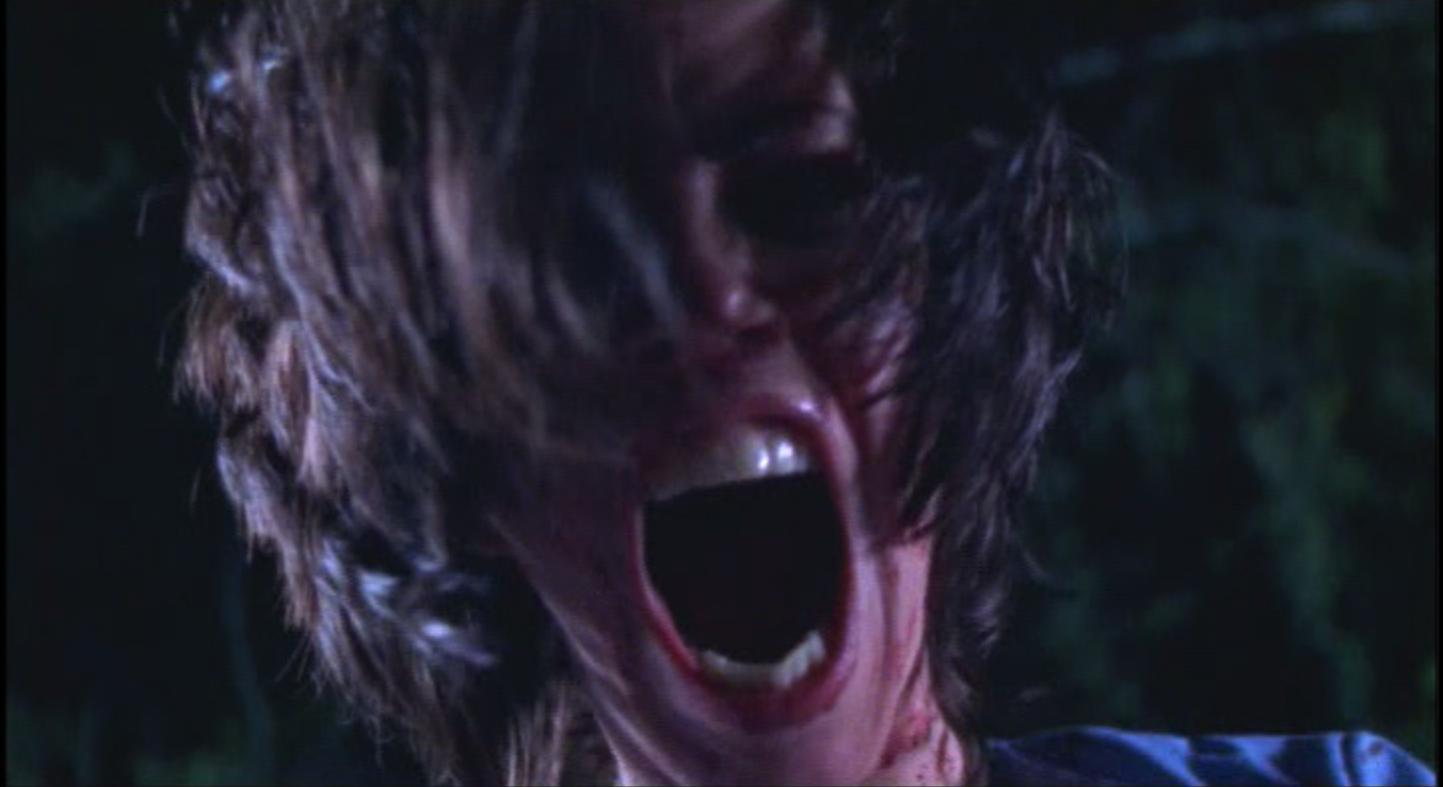
"You fuckin' bitch!" Jane screams as she bashes Trisha with her bare fist. "Who do you think you are? You think you're fuckin' better than me!"
An enraged scream rips from her lungs.
Hell hath no fury like a homicidal nurse scorned deep in the heart of Texas.


AMERICAN NIGHTMARE (2002): Jane Toppan (Debbie Rochon) screams with rage


Several Halloweens later, Jane sashays into a coffee shop where a group of happy-go-lucky twenty-somethings sit around listening to a pirate radio show hosted by a snarky DJ named Caligari. Unaware a violent psychopath is listening in, the friends call into Caligari's Halloween show in which guests confess their worst fears. Well, all of them except Final Girl Jessie, who is still grieving over the Halloween murder of her sister, Trisha, and prefers to spend the night baby-sitting for BRINKE STEVENS.
Jane begins stalking and murdering the friends one by one, in ways that use their own deepest, darkest fears against them.

AMERICAN NIGHTMARE is a surprisingly enjoyable shot-on-video slasher, ripping more than a few pages from HALLOWEEN (a TV-enraptured Lindsey Wallace type even watches Carpenter's film) and SCREAM. The cast is likable enough and BRANDY LITTLE, apart from one lame crying scene, is a pretty good Final Girl. She's down-to-earth and vulnerable, but still conveys the inner-strength that will allow Jessie to fight and survive. Most low-budget movies shot on video end up looking amateurish and cheap -- but this one doesn't. The photography is professional and the film manages some striking visuals. My biggest complaint is that it starts to lose steam in its third act and the characters start doing things that would be considered boneheaded even by '80s slasher standards.

But the jewel of the film is undeniably DEBBIE ROCHON as Jane. MS. ROCHON has dedicated her career to playing tortured, troubled and usually violent women and therefore deserves the Descent Into Madness Crown. She has commented publicly about her own tragic childhood filled with abuse, abandonment and living on the streets of Vancouver as a teenage runaway; I think she is remarkable in that rather than become one of the Manson Girls she has channeled her demons into her art and plays them instead.  Able to empathize as a wounded person herself, ROCHON delivers a powerful, emotionally raw performance.


AMERICAN NIGHTMARE (2002): Misty sees Jane is lurking behind her in the mirror's reflection


Jane, based upon and even named after a 19th-century serial killer in Boston, carries her demons with her wherever she goes. She is driven by an uncontrollable rage, and when she finally has the opportunity to unleash it she is like a woman possessed, emitting the kind of screams that only emerge from festering wounds and deep reservoirs of anger. Jane is on more psychiatric medication then Butch McGill's law partner on a weekend bender, but it doesn't soothe the pain inside or quell her compulsions to kill. In fact, she is infuriated by the fact that she doesn't understand her impulses. "Why?" she shrieks. "I wanna know why! Everybody wants to know why!" Like her male counterparts in MANIAC and HENRY: PORTRAIT OF A SERIAL KILLER, she has been deeply wounded by past trauma and compelled to hurt others as badly as she has been hurt.
Why else would someone direct that much rage and violence at Jessie's largely forgettable friend Melanie?
She is flirtatious and sensual, but she despises being touched, implying a history of sexual abuse. In fact, Jane's anger turns inward too as self-mutilation is a masturbatory act for her.
The morning after her homicidal spree, Jane lies on her bed and sobs uncontrollably. She's vented her emotions through violence, but she still feels no relief. She will continue until her demons consume her.


AMERICAN NIGHTMARE (2002): Jane (Debbie Rochon) threatens to slit Jessie's (Brandy Little) throat


Though she has targeted Jessie because she is the sister of her perceived betrayer, Jane really resents the friends because of their carefree lives and the warm bond they have with one another. Those are the things she has been deprived of by no fault of her own.
There were times in my life I could relate to Jane. As someone who had more of her fair share of hurt, rejection, abuse and abandonment, I often felt possessed by rage. I didn't trust anyone who was normal or happy and I resented the judgmental people who went out of their way to be horrible to me but still seemed to have better lives then I did. I wished I could give it all back to them, but ultimately what good would that do me?

I actually wish the film featured more of Jane's character and less of the by-the-numbers slice n' dice aspects (as much fun as those are). This is one of the few times I would welcome a sequel to a no-budget shot-on-video-direct-to-DVD post-SCREAM slasher. C'mon filmmakers, I wanna see Jane Toppan rampaging because she's pissed off and withdrawing from numerous psychiatric meds in AMERICAN NIGHTMARE 2!


AMERICAN NIGHTMARE: newspaper article about Jane Toppan's hospital murders