Dedicated to the exploration of madness, mayhem and violence perpetrated by women in film, literature and television.
Showing posts with label slasher. Show all posts
Friday, May 13, 2016
The Kids Are All Dead
That's it, I've had it. I had to shoot four or five hipsters today. And it's not just because I've had more than my fill of stupid hats and manufactured ennui. The term "hipster" did not always apply to such an odious breed of the human race. In the '50s, a hipster was someone who felt alienated from consumer-driven mainstream society, embraced the offbeat and drifted around on an existential quest. Hey, I can get behind that! Now a hipster is a sheltered, entitled "artiste" from an affluent suburban family armed with a self-absorbed arrogance disguised as irony who tries to dress like a homeless person. And being a poverty poseur in an economic recession is just downright rude.
While subcultures of past generations all believed in something, hipsters only believe in their own "coolness." Instead of rejecting the mainstream culture and creating their own fashion, music and art, all hipsters have to offer is a feigned superiority that only allows them to like things ironically. And while other subcultures from past generations were united by common beliefs, similar tastes in music and shared attitudes about the world, hipsters don't even like other hipsters. It's a crowd of one; a self-admiration society.
Is this really the best my generation could come up with? I guess that's what happens when parents instead of raising their kids to be self-reliant, to think for themselves, to go make mistakes and figure things out, produced a bunch of narcissistic whinemeisters who were taught that their feelings mattered more than accomplishment, had all of their time managed for them and were sheltered from anything too offensive or scary. HUNTER S. THOMPSON once wrote of The Generation of Swine. This is Generation of Wussies.
Lest you think hipsters are harmless, keep in mind these post-modern putzes invade every city and drive up the cost of rent for those who actually work for a living. They've infested Austin and New Orleans like a particularly obnoxious zombie apocalypse. And now I can't go to a midnight movie without a goon squad of these boho buttheads cackling like rabid hyenas after every single line to convey they only like the movie because it's "sooooo stuuuuuupid."
I won't stand for this skinny-jeans sporting skullduggery. I've got my machete handy and I'm heading out to every Whole Foods and coffee house in the country to send all these unnecessary headband-wearing wimps back to the ninth circle of hell where they came from.
And speaking of killing sprees, today's Friday the 13th! Thanks to the folks at Paramount Studios, the day will always be associated with Jason Voorhees, a drowned disabled boy turned unstoppable boogeyman killing machine who goes down only to rise again and again for vengeance, much like Otis Calhoun after too many tequila slammers at Crabs and Crabcakes Singles Night. But before all the sequels there was a low-budget popcorn movie attempting to cash in on the success of HALLOWEEN. And before Jason, there was his devoted mama, Mrs. Voorhees. Today I'm talkin' about the movie that started it all and that's the one and only FRIDAY THE 13TH (1980) directed by SEAN CUNNINGHAM, producer of the infamous LAST HOUSE ON THE LEFT and written by New Orleans-native VICTOR MILLER.
We all know the story: In 1958, a pair of counselors at Camp Crystal Lake are brutally murdered when they sneak off from the rest of the crowd to make the beast with two backs. 21 years later, Camp Crystal Lake is thought to be cursed by the locals, but that doesn't stop Steve Christy from buying the place and planning to open it back up. Despite the hostility from the DELIVERANCE-lite townspeople, a group of college-aged kids (one of which is a young KEVIN BACON) help Steve make renovations, prepare to be counselors and have some summertime fun out in the New Jersey woods. However, an unseen assailant is stalking and murdering them one by one. When a storm strands them at the camp without power or help, only final girl Alice Hardy (ADRIENNE KING) is left alive to face the killer.
And it's not Jason.
The culprit is Pamela Voorhees, Jason's mother. Seems twenty-one years ago, two hormone-crazed counselors abandoned their duties to go play whack the weasel off in the bushes and negligently allowed her disabled little boy drown.
There's nothing quite like a mother's love.
Or the agony of a mother's grief.
FRIDAY THE 13TH, while an unexpected box office hit, was lambasted by critics upon its release (my personal favorite critique declared it, "The cinematic equivalent of belching in art class") mostly for its (for the time) graphic violence and perceived puritanism. Sure, FRIDAY THE 13TH is kind of a pale imitator of MARIO BAVA's outstanding proto-slasher film BAY OF BLOOD, without really matching the style, wit or finesse of its forebearer. But it's hardly the blundering clunker that critics have made it out to be; the production is lean and competent. While slasher films (sometimes rightfully) draw derision for poor acting, the cast here does a good job and brings a lot of their enthusiasm to their roles. Seasoned pro BETSY PALMER gives a bravura performance as Mrs. Voorhees, perfectly illustrating the intense rage that would drive a grieving mother to mass murder. I can't imagine anyone else delivering the line, "Look what YOU DID TO HIM!" with as much delicious venom as she does.
SIDENOTE: ESTELLE PARSONS was at one point cast as Mrs. Voorhees. As much as I love BESTY PALMER in this movie, I would have loved to see what ESTELLE PARSONS would've brought to this part.
As for the puritanical aspect of the film, I'll discuss that more in a bit but the criticism leveled at the film that the virginal girl survives while all of her sexually active friends are mutilated is unfounded. From their interactions together, the viewer can easily draw the conclusion that Alice has been sleeping with Steve Christy. Then she throws him over to openly flirt with fellow counselor-to-be, Bill (HARRY CROSBY, son of BING CROSBY).
Virgin she is not.
Alice, like all final girls whether virginal or not, is drawn as an introspective observer (she's an artist) and resourceful enough to survive the night.
However, I may be alone in this, but I always wish that Brenda (LAURIE BARTRAM) had been the final girl. Though she sports some stylish turquoise jewelry, Alice just kind of bugs me, okay? Brenda's intelligent, sarcastic, reads for fun and is sassy enough to instigate a game of Strip Monopoly.
And I thought she and wise-cracking, BOGART-impersonating jokester Ned would've made a cute couple.
Oh, Brenda, though you did not survive the movie, you'll always be Final Girl in my heart.
The violence in the film, thanks to relaxing censorship standards and rapidly improving special effects, was definitely more extreme for its time, but really not as extreme as its reputation suggests. Aside from a few "money shots," the film relies more on suspense generated by the film's craftsmanship (particularly the PSYCHO-inspired score by HARRY MANFREDINI and the killer's POV device borrowed from giallo films). The pioneering special effects by Wizard of Gore TOM SAVINI (fresh off DAWN OF THE DEAD) still pack a punch today, but the violence in the film is never mean-spirited or sadistic as it is in a lot of recent horror films. It has the quality of a haunted house at Halloween time: the filmmaker's want you to have fun being scared and to wonder how they were able to pull off such neat visual tricks.
The violence is stylized rather than realistic. If you've ever seen crime scene photos, people's hands and arms are completely battered from defensive wounds. There are some murder victims who don't even look human anymore.
But in FRIDAY THE 13TH no one fights for their life; these kids have zero survival instinct and two of the film's victims even stand completely still for the convenience of the killer. This is a pretty far cry from the agonizing violence of LAST HOUSE ON THE LEFT. Violence here is spectacle.
It's hard to see what critics back then were making such a fuss about, but then again old fuddy-duddies always have to have something to get upset about.
And speaking of old fuddy-duddies, generational conflict is at the heart of FRIDAY THE 13TH and part of the reason it resonated with young audience members. Mrs. Voorhees, judging by her age in the film, is a member of The Silent Generation: she grew up in The Great Depression, most likely experiencing a childhood of austerity and struggle. Not only having endured the worst economic crisis in American history (although the 2008 crash is trying to give it some serious competition) and World War II, her young adulthood lands her in the ultra-conservative, McCarthyist '50s where any rebellious behavior is labeled dangerous and anti-American. While it's the Silent Generation that brought us iconic screen rebels MARLON BRANDO, JAMES DEAN, PAUL NEWMAN, WARREN OATES, CLINT EASTWOOD and JACK NICHOLSON (to name only a few), conversely the Silent Generation was characterized by their reserve and keep-a-stiff-upper-lip-resilience. Decades of cultural storm had silenced their youthful expression.
On the other hand, the kids in FRIDAY THE 13TH came of age in the privileged '60s, matured following the cultural upheaval of the late '60s and '70s and entered young adulthood in the affluence and hedonism of the late '70s. Just as FRIDAY THE 13TH rose from relaxing censorship standards for sex and violence, the kids in the movie grew up following radically changing cultural attitudes regarding sex and gender roles. While I'm sure members of Mrs. Voorhees' generation engaged in pre-marital sex and drug abuse, with the new generation it was taken out of shadows.
The kids in FRIDAY THE 13TH are pretty far from the entitled, instant-gratification seeking douchebags featured in later slasher movies (and some of the FRIDAY THE 13TH sequels): they've taken a summer job in the middle of nowhere working with children for crying out loud. After days of painting and fixing gutters, if they want to goof off a little, it's well-earned.
Besides, Marcie (JEANNINE TAYLOR) does KATHERINE HEPBURN impressions just to amuse herself. What's not to like?
However, Mrs. Voorhees, has embraced the conservative morality of the '50s and carries with her the stern values from her Depression-era childhood. She is emblematic of the older generation's hostility towards the new generation.
She probably reminded young audience members of all of the disapproving adults in their lives.
You've got to feel some sympathy for Mrs. Voorhees. After a hard-scrabble childhood, she's raising a disabled son all alone on a minimum-wage salary as Camp Crystal Lake's cook. And as a summer camp cook, it's got to be one in a series of temporary, intermittent jobs. There are not a lot of resources for disabled children now - especially on Mrs. Voorhees' limited income - and there were even fewer back then. One who has dedicated their life to hard work and caring for a disabled son does not usually have the opportunity to create an extended social network for support; when Mrs. Voorhees lost Jason, she lost everything. And worst yet, she lost him due to the irresponsibility and selfishness of people who were put in charge with his care.
And who wouldn't want to kill those two counselors?
Not only did they not get fired for allowing a little boy to drown because they couldn't keep their pants on, they're still making gooey eyes at one another without a shred of guilt!
I'm with Maw Voorhees on that one -- those self-absorbed jerk-olas were in need of a harpoonin'!
Mrs. Voorhees, though - like many of her cinematic sisters I've discussed on this blog - clings to her grief. She's unable to heal so her grief turns into intense rage. Camp Crystal Lake becomes the focus of her anger. Remember when the locals were saying there were mysterious fires at the place and one year the lake was even poisoned?
That was Mrs. Voorhees' way of saying "talk to the fist, 'cause the face is pissed."
Jason even speaks to her from beyond the grave.
"Kill her, Mommy!" she says to herself in a child's voice.
The current counselors have nothing to do with her son's death. And spunky Annie, the ill-fated would-be camp cook, who declares she wants to dedicate her life to working with children, would have only been attentive and kind to a child like Jason. However, it doesn't matter: Mrs. Voorhees just wants others to hurt as badly she's been hurt.
It's really hard to agree with those cranky ol' critics that thought FRIDAY THE 13TH represented the decline of Western civilization. Like all movies, it was a result of different things brewing in the culture at the time. And while critics decried the violence in the film, a fear of random acts of violence permeated the '70s. Already a turbulent decade of war and riots, Alice and her friends would have caught glimpses of news stories about the Manson Family murders, Charles Whitman and the Texas Tower shootings and the multi-state serial killing spree of Ted Bundy all before they graduated high school.
When the film was produced, being brutally butchered by a faceless assailant wasn't a horror trope: it was a real and terrifying possibility.
So there you have it: the film that launched a thousand sequels and the mayhem was all spawned from a mother's love. It's kind of interesting that Jason became the icon of the series, transformed from plot device/victim to superhuman murder machine powered by some unexplained supernatural phenomenon and the greed of the Paramount executives. But wouldn't it have been kind of great if Mrs. Voorhees had become the horror icon? I know, I know, she gets decapitated by Alice at the end of this one and it's kind of awkward to get around with no head. But, hey, Jason's been decapitated, burned, electrocuted and impaled and he always comes back, so why not Mrs. Voorhees? They could've figured out some creative way for her to get her head back. Or just not even bothered to explain it. It's not like the FRIDAY sequels are known for incorporating logic. I think an undead unhinged mama out for revenge would have made a helluva franchise. Instead of a faceless monster crushing heads, throwing people through windows, murdering people on toilets and stalking people performing nerdy '80s dances, it could have been a zombied-out BESTY PALMER!
What a missed opportunity!
Friday, November 6, 2015
Beware of the Naked Man
Pardon me while I old all over the place, but a lot of things were better in olden times. Jobs were plentiful. Fewer guys named Todd. Political correctness was non-existent. Hipsters had yet to infest every city center with their ham-fisted attempts at irony. People weren't perpetually auditioning for their own reality-TV show. But most importantly of all, there were video stores. I know there are a few jerks out there who'll pipe up and say, "But it's so much more convenient to stream - any movie you want is available at just a click of a mouse!" I will retort first by saying, "Get off my damn lawn, you whippersnapper!" And second, for those of my readers that did not come of age during the magical era of VHS, there was just something special about taking a journey to your local video store.
First of all, you didn't have the privilege of remaining isolated and you were forced to know how to interact with other people to obtain the movies of your choice. And sometimes instant gratification just isn't everything. LAST HOUSE ON THE LEFT, ERASERHEAD, SLEEPAWAY CAMP and HENRY: PORTRAIT OF A SERIAL KILLER hold so many more special memories for me because I had to embark on a quest to find them.
Once you arrived at the video store, you had the chance to browse through rows and rows of creative box art and discover hidden gems. That's how I stumbled upon ALICE, SWEET ALICE and that remains one of my favorite movies to this day. On the other hand, that's also how my high school best friend and I ended up renting NAIL GUN MASSACRE. This was before the day of hideously Photoshopped floating heads, so looking at all the box art was a thrill in itself.
Then when you finally selected your movie, you got to talk about your rental with the sardonic clerk who had ostensibly seen every single movie in the store.
And now that video stores are gone, where the hell are smart-alecky people who have seen too many movies supposed to work? Automating people out of business is how that TEXAS CHAIN SAW MASSACRE family got started!
And do we really want to give away all of our jobs to machines? We're turning this whole damn country into WESTWORLD!
These are the thoughts that kept me out of all the good schools.
And speaking of thoughts that kept me out of all the good schools, let's celebrate everything I loved about the heyday of VHS and also CHARLES BRONSON's birthday week with 10 TO MIDNIGHT (1983), a sleazy slasher-inspired action flick from those bastions of good taste at Cannon Films.
The Bronsonator plays Leo Kessler, a hard-nosed quiche-hating Los Angeles homicide detective who's tired of creeps finding loopholes to evade justice. With the help of college-educated new partner Andrew McCann (ANDREW STEVENS), Kessler investigates a series of homicides of young woman. The perpetrator is none other then Ted Bundy-inspired (he even drives a tan VW bug!) office equipment repairman, Warren Stacy, who despite his buff physique has trouble attracting a date. Warren's misogyny and painfully fragile masculine ego prevent him from relating to women as anything other then contemptible pleasure objects and does not understand why his condescending, abrasive advances are met with rejection.
Hell hath no fury like a developmentally arrested man-baby scorned, and Warren stalks his unrequited objects of lust before stripping buck naked and stabbing them to death. Not only does this method of murder serve as a substitute for sex in which Warren can have total dominance, but also conveniently does not leave physical evidence.
Warren also has a knack for arranging airtight alibis, which makes Leo's pursuit of him all the more difficult. When Warren sets his perverted sights on Leo's feisty student nurse daughter, Laurie (LISA EILBACHER), Leo decides to take a shortcut and plant a little evidence.
Unfortunately, Warren just hires cynical, amiably sleazy crackerjack criminal defense attorney Dave Dante (character actor extraordinaire, the late beloved GEOFFREY LEWIS) and is sprung free to pull a Richard Speck and slice and dice a houseful of student nurses into veal cutlets.
Then it's time for the Bronsonator to dispense some good ol' fashioned street justice.
Other reviewers have noted that 10 TO MIDNIGHT has much more in common with DIRTY HARRY than the DEATH WISH films for which BRONSON became famous, with its disillusioned detective, sadistic serial killer and critique of a criminal justice system that does nothing to protect its citizens from savvy predators. 10 TO MIDNIGHT also incorporates elements of slasher films, which were extremely popular at the time. The first victim is dispatched FRIDAY THE 13TH-style while having sex with her boyfriend in a van parked in the woods. Warren's systematic stalking and slashing of the house full of student nurses is a cornucopia of slasher tropes including a shower attack, a potential victim hiding under a bed while another victim is stabbed to death right above her and a prolonged chase of the Final Girl.
And can you really die from being stabbed in the stomach because according to this movie and the FRIDAY THE 13TH sequels, that's completely plausible.
It's a pretty well-acted and entertaining movie. J. LEE THOMPSON, stalwart action director who helmed the Gothic-infused slasher delight HAPPY BIRTHDAY TO ME a few years earlier, keeps everything stylish and snappy. BRONSON brings his usual likability and commanding presence to a stock role. Likewise, ANDREW STEVENS is good as his more ethical idealistic partner and potential love interest for the leading lady. My favorite, though, is LISA EILBACHER as Laurie Kessler. Most slasher movie Final Girls are still in their teens or in college, but Laurie is a grown woman trying to overcome childhood baggage as she progresses through adulthood. Though she still has a relationship with her father, it is clear he was often estranged from her and eschewed his parenting duties for the sake of his career. With the loss of her mother at a young age, Laurie ostensibly raised herself. Though she bears some reasonable resentment, she is not portrayed as incomplete or damaged. She is confident, tough-but-vulnerable, sassy and resourceful under distress. EILBACHER is refreshingly natural in the role and as a result, Laurie is always relatable.
GENE DAVIS is unfortunately wooden as Warren Stacy, often coming off as petulantly pissy rather than cold-blooded. However, the portrayal strangely works in the character's favor: a grown man pitching tantrums is far more repellant than any psychopath.
And you will never hear anything but gushing praise from me about GEOFFREY LEWIS, particularly when he is playing a gleefully sleazy attorney.
But while 10 TO MIDNIGHT is shamelessly entertaining, let's look at its depiction of the legal system.
Real life has little influence over Hollywood and I doubt any producers have been in a court room unless it's for their own cocaine possession. Therefore, 10 TO MIDNIGHT's sanctimonious assertion that the system is broken is pretty riddled with holes.
I can't exactly say the same for its brethren DIRTY HARRY, which arose from '70s cynicism about the institutions we constructed to protect us but failed to do so and fear that perhaps society had gone too far to one end of the spectrum to ever return to a balanced center.
In Harry Callahan's hunt for Scorpio, he acts under a ticking clock, determined to save a teenage girl who has been buried alive with only a few hours to live. He adheres to the rules until necessity dictates otherwise. I can't speak for Constitutional law in the early '70s, but Harry's obtaining Scorpio's rifle (which he does in the course of his legitimate search for Scorpio) and finally catching Scorpio himself are acceptable considering the extraneous circumstance. And while roughing up Scorpio would have a penalty, a human life hanging in the balance takes precedent over the right to a lawyer.
Harry Callahan cries that "the law's crazy" because he has done the right thing to save a young girl's life and prevent a dangerous (not to mention racist, homophobic and misogynistic) psychopath from hurting others. He is prevented from maintaining justice for the people by heartless bureaucrats who seem to care more about technicalities of the law than the citizens those laws were created to protect.
On the other hand, Leo Kessler planting evidence on Warren isn't in pursuit of justice, just sloppy police work. He is emotionally invested because Warren has involved his daughter and takes a short-cut.
I also don't think it was proper police procedure to illegally seize Warren's sex toy and brandish it at him during an interrogation ("Do you know what this is for? It's for jackin' off isn't it?" Leo snarls). No matter how freakydeaky he thinks it is, it's irrelevant to the murder investigation and I doubt he could get a judge to sign a warrant for it.
10 TO MIDNIGHT would have us believe the criminal justice is full of loophooles in which clever criminals are all able to afford top-notch lawyers and manipulate their way back onto the street as wishy-washy liberals wring their hands and shrug over technicalities.
The legal system is flawed and not always fair (might equals right far too often), but not in the way the film depicts.
There's a misconception that Constitutional rights are only there to protect murderous psychopaths and child molesters go free, when the most commonly quoted statistic is that 97% of criminal defendants are ruled guilty.
Most of the judges in criminal court (at least where I live) are former prosecutors and therefore inclined to believe everyone is guilty. And there are a large chunk of defendants not poor enough to be eligible for a public defender but too poor to afford a private attorney, so most go without the skilled representation of a legal artist like Dave Dante.
And the number of defendants freed due to technicalities, in my experience, are zero. Exceptions are made if the investigating officers were acting in good faith. If a defendant is acquitted due to their Constitutional rights being violated, the investigating officers were negligent or corrupt in performing their duties.
In fact, if Warren Stacy were not such a despicable creep, the audience would be howling over lack of police ethics.
I also doubt that an attorney as savvy as Dave Dante, no matter how unethical, would propose an insanity plea as an alternative to the death penalty when there is clear evidence that the defendant was aware his criminal actions were wrong. Additionally, in California (as in several other states) the burden of proof would be on the defendant so I doubt this would have been proposed as a cavalier solution.
Though Leo remarks that Dave Dante is scum, Dave is the one who is just doing his job. Everyone is entitled to the best defense possible (or at least one within their financial means) and Dave is simply defending his client to the best of his ability. It's Leo's sloppy and unethical police work that guarantees Warren Stacy will go free.
In the context of the film, I love the ending. It's dramatically satisfying and I don't know if anyone could have brought as much gravitas to that moment as CHARLES BRONSON does. However, in the context of the real world, Leo Kessler would then be rushing to obtain the services of a Dave Dante-type criminal lawyer he once hypocritically denounced.
Would the system still be considered to be broken if Leo were to be acquitted for murder? That's a question the film doesn't bother to consider.
Well, Constitutional law aside, 10 TO MIDNIGHT is good ol' fashioned exploitation fun and I don't think it's ever possible for me to dislike a CHARLES BRONSON movie. Even in those later DEATH WISH sequels where he starts rockin' sweat suits and starts to look more like ED ASNER, I still just love the guy. ROGER EBERT declared 10 TO MIDNIGHT to be "a scummy little sewer of a movie" and that "the people who made (it) have every reason to be ashamed of themselves." That's quite a compliment from the guy who penned the great trash classic BEYOND THE VALLEY OF THE DOLLS!
And while searching for a clip of the ending, I discovered this clip which made me love the Bronsonator even more.
I knew we were always on the same page!
Monday, November 2, 2015
Death Has Come To Your Little Town, Sheriff
By the time I post this, it will be after midnight, but it's Halloween every day of the year in my heart. And there was a hell of a night in my neighborhood too. Those jerks across the street, of course, had their Hallelujah house with undead cheerleaders gushing blood from botched abortions and gay men transformed into monsters by some unspecified disfiguring STD.
I thought maybe Otis Calhoun had given up. I thought maybe that prison bromance had softened him up.
But nobody bears a grudge quite like a Southern redneck.
In the distance you could hear the growl of the motorcycle and the sound of two men howling like wolves. Then out of the darkness of the night, Otis Calhoun emerged, riding on the back of his brother Lyle's motorcycle, dressed as Bluto from ANIMAL HOUSE and carrying a jack o' lantern with one hand and a Wild Turkey bottle in the other. He bellowed something that sounded like, "Chug a beer for Satan!" and, like he did many years before, hurled the jack o' lantern straight through the brand new picture window. Then Lyle plowed the motorcycle straight through the garage where Otis sprayed all the Hallelujah house with bourbon.
From that point on I lost track of all the mayhem, but there are emergency vehicles around the block and it looks like the Thomas's garage is on fire. I have a feeling November is going to be a busy month for Otis Calhoun's parole officer and Butch Walker, who's excited that Otis is back on the streets because he needs a new car.
And speaking of Halloween mayhem, it's time for the film that inserted the holiday into the annals of horror history. That's right, before JOHN CARPENTER and DEBRA HILL came along no one had made a horror movie about Halloween before. The tenth film in the 31 Days of Halloween review-a-thon is none other then the seminal low-budget classic HALLOWEEN (1978) written by DEBRA HILL and JOHN CARPENTER, directed by JOHN CARPENTER and starring the ultimate Scream Queen JAMIE LEE CURTIS as the shy babysitter besieged by the boogeyman.
Even if you haven't seen the film, you know the plot and it was re-used and re-invented countless of times by both independent and studio imitators.
The film opens with a point-of-view tracking shot through a house on Halloween night. This is already disorienting to the audience as we don't know who we are or why we're grabbing a butcher knife out of the kitchen drawer. We are both a helpless voyeur and complicit as seventeen-year-old Judith Myers is stabbed to death after having sex with her boyfriend. And the guy was a total minute man too.
To our shock, we discover the perpetrator is six-year-old Michael Myers, her little brother.
Fifteen years later, Michael's psychiatrist Dr. Samuel Loomis (veteran DONALD PLEASENCE) insists Michael should never be released; He's purely and simply (dramatic pause) evil.
But before he can be transported to a maximum security institution, Michael escapes and heads back home to Haddonfield, Illinois, right in time for Halloween.
Shy, thoughtful Laurie Strode (JAMIE LEE CURTIS) has an evening of baby-sitting planned while her more extroverted friends sardonic Annie (CARPENTER regular NANCY LOOMIS) and boy-crazy Lynda (cult favorite P.J. SOLES) are trying to sneak some sex and underage drinking into the mix. But little do they know of the evil that is stalking them...
Many reviewers interpreted the film as reactionary and puritanical due to the fact that the virginal Laurie survives the night while her sexually active friends are made into mince-meat, but I think this is an overly-simplistic view. HALLOWEEN was created in an eye of a cultural storm: after a decade of social upheaval and economic crisis, there was finally calm and affluence. I'm sure many were convinced this return to stasis would not last and this contributes to the point of view of the film that we are never really safe, no matter how many protections we have.
Evil is not in an Old Dark House or in the rural badlands: it has invaded upper-middle-class suburbia.
In some sense, the Michael Myers character is a reaction to the cultural results of the feminist movement and the sexual revolution but not quite in the way most reviewers have hypothesized. CAROL J. CLOVER, writer of the brilliant MEN, WOMEN AND CHAINSAWS, has stated the audiences for HALLOWEEN and the slasher films that followed are "the children of feminism." Following both social movements, the divorce rate rose substantially and the family dynamic changed permanently. Many children now came from homes with a single, working parent and did not have as much supervision and attention as their counterparts of previous generations.
At the same time, because of the economic boom following a decade of turmoil, society shifted from social consciousness to instant gratification.
Michael Myers is representative of the anger of the latch-key kid generation which lost some of their own childhood due to the actions of adults.
His older sister, who is supposed to be taking care of him, ignores him to have sex with her boyfriend. It is not the act of having sex that signs these character's death warrants: it's the preference for instant gratification over responsibility.
Sex in American culture is perceived as an entrance into adulthood. Therefore in horror films, it's not sex being demonized but the fear of adulthood and the loss of childhood innocence.
Michael, in his fear of adulthood, remains a developmentally arrested child. When he is briefly unmasked near the end of the film, his facial features are child-like and boyish. Like most Americans, he is repelled by sex and cannot perceive women as anything other than mothers or whores.
His inability to mature and to comprehend the changing world around him in turn causes him to completely lose any sense of identity or personality. He becomes nothing but a robotic killing machine seeking out sister surrogates to punish, all the while wearing a featureless mask.
HALLOWEEN, like all horror films about teenagers, is a coming-of-age film underneath all the stalkings and stabbings. Laurie is far more responsible then her instant gratification-seeking friends. She's on the other end of the spectrum, completely selfless and always doing things for other people. But Laurie is at an age where she is deciding what kind of woman she would like to be. Like Michael, she has reservations about adulthood but she does not allow her fears to arrest her. Though introverted and studious (her hobbies are reading and knitting), she is not quite the prude that many reviewers construe her to be. After all, she gets high with Annie right before her baby-sitting job. Like most teenagers, Laurie is curious about sex and romantic relationships, but she's not going to rush into anything before she is ready. Unlike her friends, she knows both these things entail responsibility. The deaths the sexually active characters face, in addition to the death of their childhood, could also represent the ramifications of sexually transmitted diseases and unwanted pregnancy.
"Guys think I'm too smart," she shrugs.
Laurie's transition into adulthood is achieved through survival; she is resourceful and courageous in the face of adversity. In surviving her battle with Michael Myers, she not only grows from child to woman, but grows into the kind of woman that she wants to be, rather than what other people want her to be.
It's arguable over which horror movie character deserves the title of First Final Girl, but its undeniable that Laurie is the template future Final Girls adhered to.
I really resent those boneheads whining that HALLOWEEN is anti-feminist when Laurie demonstrates herself to be intelligent, resourceful and strong. She would like to have a boyfriend but is independent enough that she does not need one to define herself.
Laurie Strode is a feminist.
And while I'm talking about strong, resourceful women, let me take a moment to give a shout out to the late DEBRA HILL. Not only did she co-write and produce one of the most influential horror films of all time, but she rose through the ranks of low-budget horror to become a successful producer in male-dominated studio Hollywood. That's no small feat, I can tell you.
But as much as I love Laurie, Annie Brackett may be my favorite character. The sarcastic best friend is a favorite horror movie trope of mine as that's the role I play in real life. Though I would probably face sudden death at the knife blade of a masked maniac for being so sassy, I just can't shut my mouth. NANCY LOOMIS grants her a terrific HIS GIRL FRIDAY-style snappy delivery, and aside from Dr. Loomis, has the best lines in the movie.
"I hate a guy with a car and no sense of humor."
And what about Dr. Loomis you ask? It's through his character that the film explores the concept of evil. In HALLOWEEN, evil has no explanation. Do we ever really find out the specific reasons why a six-year-old boy would stab his sister to death? The sequels would posit all kinds of theories but here, there is no real explanation. The graveyard cartetaker, Mr. Lowry, tells Loomis another tragic story involving hacksaw mayhem one town over, remarking that "every town has something like this."
Evil is not exclusive to Haddonfield it is everywhere in every small town in America. As mentioned before, no one is safe from it. Even Laurie in her hesitancy to take risks is not safe.
Evil in HALLOWEEN is an unstoppable force of nature. In Laurie's high school philosophy class, the lecture focuses on the idea of fate.
"Fate is immovable like a mountain...fate never changes," the teacher lectures.
Perhaps this implies that the mayhem transpiring on Halloween night was meant to happen and there are larger forces at work.
He is equated by Tommy Wallace, Laurie's baby-sitting charge, to the boogeyman: an all-purpose monster symbolizing all things that are malevolent to children. The boogeyman, too, is a way we try to understand the forces of evil in the world through myths and stories.
Michael Myers is the equivalent of a hurricane, with no emotions or personality to hinder him, leaving a path of death and destruction.
He cannot be stopped. Laurie stabs him with a knife, stabs him in the eye with a coat hanger and stabs him in the neck with a knitting needle but he still will not die.
Even after six gunshots and a fall from the second story, Michael survives.
He is both a supernatural monster and a human monster. Supernatural in that he is more force of nature than human. He is both the inexplicable evil that men do and a vessel for the forces of evil themselves.
In the last scene of the film, Loomis looks down where Michael's body once lay and finds that it is now gone. He is unsurprised; he knew this would happen.
There is a montage of all the places Michael has been that night, now empty, as we hear his labored breathing over the soundtrack.
Not only can evil not be defeated, it's everywhere.
With his featureless white mask, robotic compulsion to kill and supernatural abilities, Michael may also represent the ultimate force beyond human control.
"Death has come to your little town, Sheriff," Loomis states.
Michael Myers is also the equivalent of the Grim Reaper and our ultimate fate that cannot be defeated, death.
As one leaves their childhood and teenage years behind, death looms a little closer.
It's through stories of the boogeyman and horror movies that we can attempt to understand the forces of evil in this world and help face our fear of death safely.
Laurie is an observant young woman and, as someone tentative to act, she is a watcher. In that respect, she is representative of HALLOWEEN's audience. Those that watch HALLOWEEN do so because they are trying to face their own fears.
While much attention has been paid to the fact that sequences in the film are shot from Michael's point of view, they forget to note that there are also sequences shot from Laurie's point of view. While Michael is a representative of evil, Laurie is a representative of good and both these forces are a part of us.
Unlike her friends, who are not interested in facing anything going on around them and instead settle for the brief escapism of sex, drinking and drugs, Laurie observes, is brave enough to investigate when she suspects something is wrong and strong enough to survive her brush with evil.
Ignoring the problem does not make it go away and it's Laurie's perceptiveness and her strength to face things rather than hide that allows her to survive the night more then her status as a virgin.
Thursday, October 29, 2015
There's a Killer in Texas
American Nightmare (2002)
My favorite movie theater was doing a Hammer double-feature, THE HORROR OF DRACULA and THE CURSE OF FRANKENSTEIN, so I went with Marie Janisse. It meant facing the unholy army of hipsters that have invaded downtown like a particularly condescending unnecessary headband-wearing zombie apocalypse and parking royally sucks, but where else can you find that level of quality entertainment for only nine bucks?
"C'mon, Marie, let's go get Hammered," I said.
Not only did we brave the expected deadly swarm of hipster douchery, Friday night traffic and an impossibly long line at the concessions stand but quickly discovered that going to the movies in America now involves a security checkpoint. Does the ticket taker really have to know that I haven't cleaned out my purse in a decade and that I keep an inordinate number of mini-Snickers in there? I think that's purse shaming and purse shaming is wrong.
"Do you think they'll let me go in with these?" Marie asked, referring to the mini-bottles she always smuggles into the movies.
"Sure, if you share," I said.
What has this country come to when honest, hard-working people can't even exercise their God-given right to go to the movies and chow down on some overpriced Milk Duds and a bladder busting extra large Cherry Coke without fear of having their head blown off by some maniac? What kind of sicko shoots innocent people engaged in the holy past-time of watching movies anyway? I miss the good ol' days when gun-toting lunatics went on rampage on college campuses because at least then they probably deserved it. More then the economy, increasingly narcissistic selfie culture, and alliance of corporation and government, I think that's a sign right there this country's going to hell.
And speaking of random acts of violence, it's time for the seventh film in my 31 Days of Halloween review-a-thon, AMERICAN NIGHTMARE written and directed by JOHN KEYES and starring DEBBIE ROCHON as Jane Toppan the killer nurse and BRANDY LITTLE as the tragedy-stricken babysitter who must put a stop to her Halloween mayhem.
The film opens on Halloween night where some beer-guzzling lunkhead college students who haven't seen FRIDAY THE 13TH are camping out in the Austin woods. Student nurse Trisha reveals she's been questioned by the police about her supervisor, Jane Toppan, who is suspected of murdering patients. Right on cue, Jane unleashes her knife-wielding fury and turns the co-eds into cold cuts.
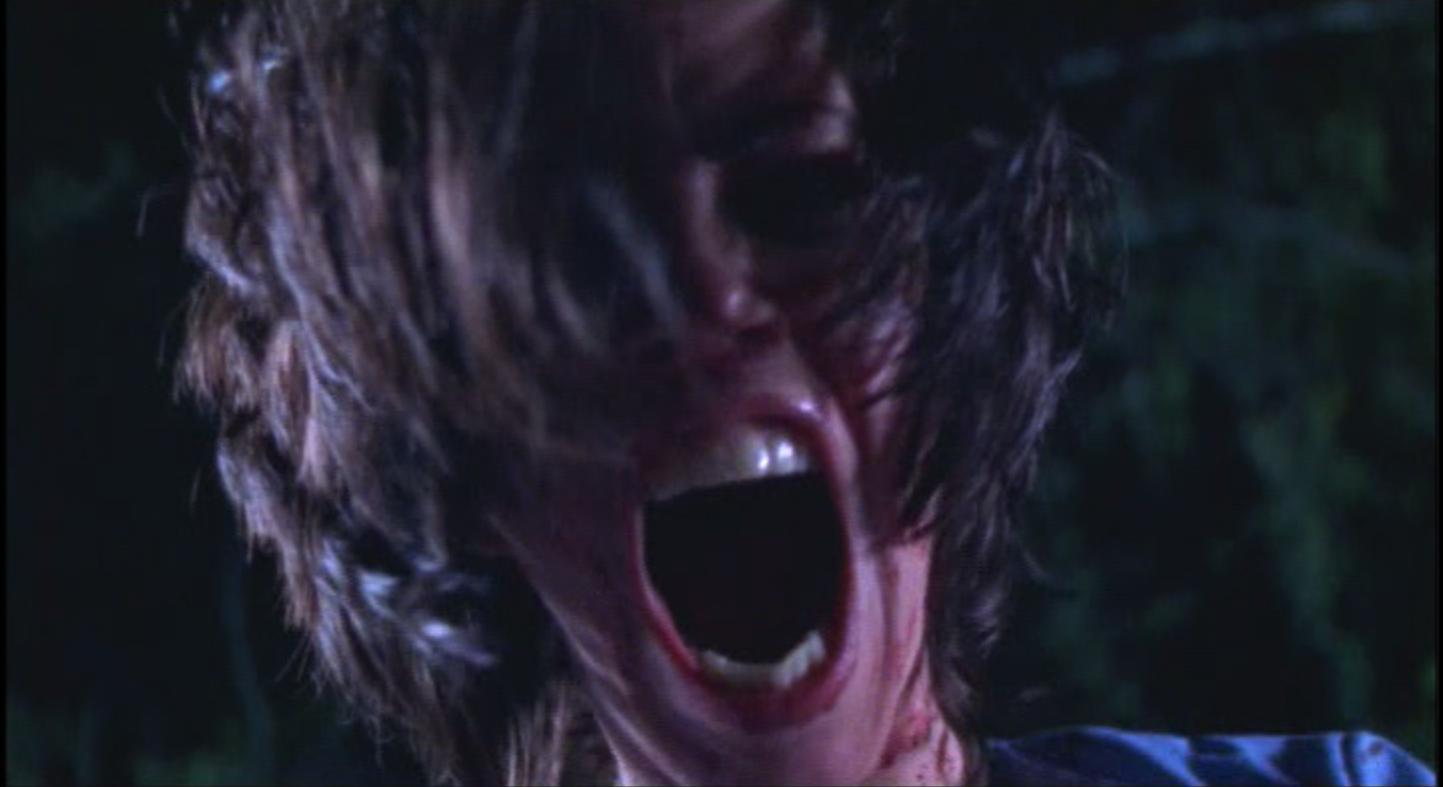
"You fuckin' bitch!" Jane screams as she bashes Trisha with her bare fist. "Who do you think you are? You think you're fuckin' better than me!"
An enraged scream rips from her lungs.
Hell hath no fury like a homicidal nurse scorned deep in the heart of Texas.
Several Halloweens later, Jane sashays into a coffee shop where a group of happy-go-lucky twenty-somethings sit around listening to a pirate radio show hosted by a snarky DJ named Caligari. Unaware a violent psychopath is listening in, the friends call into Caligari's Halloween show in which guests confess their worst fears. Well, all of them except Final Girl Jessie, who is still grieving over the Halloween murder of her sister, Trisha, and prefers to spend the night baby-sitting for BRINKE STEVENS.
Jane begins stalking and murdering the friends one by one, in ways that use their own deepest, darkest fears against them.
AMERICAN NIGHTMARE is a surprisingly enjoyable shot-on-video slasher, ripping more than a few pages from HALLOWEEN (a TV-enraptured Lindsey Wallace type even watches Carpenter's film) and SCREAM. The cast is likable enough and BRANDY LITTLE, apart from one lame crying scene, is a pretty good Final Girl. She's down-to-earth and vulnerable, but still conveys the inner-strength that will allow Jessie to fight and survive. Most low-budget movies shot on video end up looking amateurish and cheap -- but this one doesn't. The photography is professional and the film manages some striking visuals. My biggest complaint is that it starts to lose steam in its third act and the characters start doing things that would be considered boneheaded even by '80s slasher standards.
But the jewel of the film is undeniably DEBBIE ROCHON as Jane. MS. ROCHON has dedicated her career to playing tortured, troubled and usually violent women and therefore deserves the Descent Into Madness Crown. She has commented publicly about her own tragic childhood filled with abuse, abandonment and living on the streets of Vancouver as a teenage runaway; I think she is remarkable in that rather than become one of the Manson Girls she has channeled her demons into her art and plays them instead. Able to empathize as a wounded person herself, ROCHON delivers a powerful, emotionally raw performance.
Jane, based upon and even named after a 19th-century serial killer in Boston, carries her demons with her wherever she goes. She is driven by an uncontrollable rage, and when she finally has the opportunity to unleash it she is like a woman possessed, emitting the kind of screams that only emerge from festering wounds and deep reservoirs of anger. Jane is on more psychiatric medication then Butch McGill's law partner on a weekend bender, but it doesn't soothe the pain inside or quell her compulsions to kill. In fact, she is infuriated by the fact that she doesn't understand her impulses. "Why?" she shrieks. "I wanna know why! Everybody wants to know why!" Like her male counterparts in MANIAC and HENRY: PORTRAIT OF A SERIAL KILLER, she has been deeply wounded by past trauma and compelled to hurt others as badly as she has been hurt.
Why else would someone direct that much rage and violence at Jessie's largely forgettable friend Melanie?
She is flirtatious and sensual, but she despises being touched, implying a history of sexual abuse. In fact, Jane's anger turns inward too as self-mutilation is a masturbatory act for her.
The morning after her homicidal spree, Jane lies on her bed and sobs uncontrollably. She's vented her emotions through violence, but she still feels no relief. She will continue until her demons consume her.
Though she has targeted Jessie because she is the sister of her perceived betrayer, Jane really resents the friends because of their carefree lives and the warm bond they have with one another. Those are the things she has been deprived of by no fault of her own.
There were times in my life I could relate to Jane. As someone who had more of her fair share of hurt, rejection, abuse and abandonment, I often felt possessed by rage. I didn't trust anyone who was normal or happy and I resented the judgmental people who went out of their way to be horrible to me but still seemed to have better lives then I did. I wished I could give it all back to them, but ultimately what good would that do me?
I actually wish the film featured more of Jane's character and less of the by-the-numbers slice n' dice aspects (as much fun as those are). This is one of the few times I would welcome a sequel to a no-budget shot-on-video-direct-to-DVD post-SCREAM slasher. C'mon filmmakers, I wanna see Jane Toppan rampaging because she's pissed off and withdrawing from numerous psychiatric meds in AMERICAN NIGHTMARE 2!
Subscribe to:
Posts (Atom)